

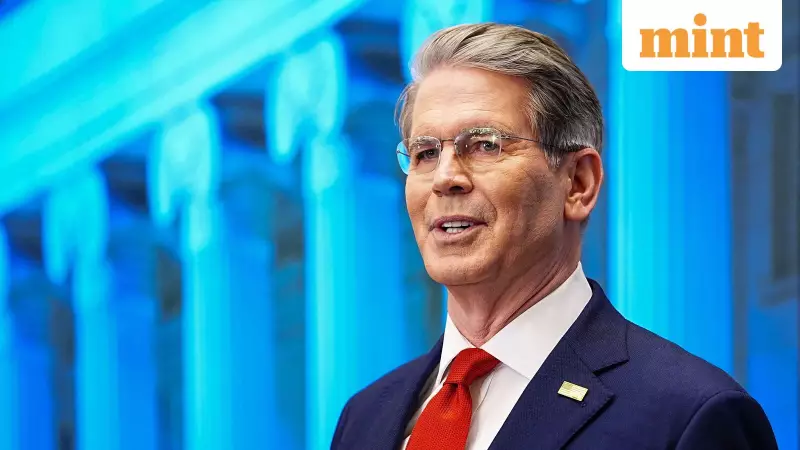
US Treasury Secretary Scott Bessent finds himself in a precarious position, with his professional fate closely tied to President Donald Trump's imminent decision on the next chair of the Federal Reserve. The selection, expected by early January 2026, represents a defining moment for Bessent, who has orchestrated the vetting process to advance his vision of lower interest rates and greater White House coordination with the central bank.
The High-Stakes Vetting Process
Bessent has meticulously managed the search for the next Fed chair, aiming to avoid the disappointment President Trump felt with his first-term Treasury Secretary, Steven Mnuchin. Mnuchin had recommended Jerome Powell, whom Trump later publicly criticized. To prevent a repeat, Bessent's primary goal has been to identify candidates who advocate for lower interest rates and support better integration between the White House and the Fed on monetary policy.
He has presented four final names to President Trump for consideration. The frontrunners, often referred to as "the Kevins," are Kevin Hassett, Trump's longtime economic adviser who leads the National Economic Council, and Kevin Warsh, a former Fed governor previously considered for the chair role. The other two candidates, Fed Governor Christopher Waller and BlackRock executive Rick Rieder, are seen as less likely choices due to their weaker personal ties with the President. A fifth candidate, Fed Governor Michelle Bowman, is no longer in contention.

Risks and Potential Backfire for Bessent
The stakes for Bessent are extraordinarily high. President Trump explicitly linked Bessent's job security to the Fed's interest rate policy in November, stating, "If you don’t get it fixed fast, I’m going to fire your ass." Although delivered with a smile, the warning underscored the serious political risk involved.
Bessent's strategy could backfire in several ways. If the chosen chair lacks credibility among Fed peers, it could hinder their ability to steer policy decisions or influence markets to lower long-term rates—a critical goal for Bessent, who describes himself as the nation's chief bond salesman overseeing the $30 trillion Treasury debt market.
While Hassett is a well-credentialed economist, some express concerns over his perceived excessive loyalty to Trump, which might undermine his effectiveness. Warsh, a longtime friend of Bessent with a shared professional background working for investor Stan Druckenmiller, is viewed as more independent. However, if Warsh or any other nominee were to defy Trump on key policies, Bessent could face dismissal or exile, much like his predecessor.
A Vision for a Transformed Federal Reserve
Beyond the personnel decision, Bessent has laid out a comprehensive reform agenda for the Fed, aiming to reshape the institution fundamentally. He advocates for a return to a historical model where the Treasury had a "seat at the table" on Federal Reserve matters. Bessent argues that while interest rate decisions should remain politically independent, other Fed powers—like expanding or contracting its balance sheet through quantitative easing (QE) or tightening (QT)—should be exercised only in "true emergencies and in coordination with the rest of government."
Both Hassett and Warsh have endorsed this vision. Warsh has been particularly vocal, calling for a new Treasury-Fed Accord, which would grant the Treasury greater influence over the Fed's large-scale asset purchases and sales. Bessent's proposed reforms also include lighter banking regulation to spur lending, downsizing regional Fed banks to eliminate research overlap, and cutting the Fed's budget, citing expensive building renovations.
Bessent believes these changes would return the Fed to a more traditional, background role. He has criticized policies like QE for inflating stock prices and exacerbating inequality, stating the Fed is "the leading cause of inequality." He envisions a shift away from a "two-tier economy" divided between asset holders and others.

Empowerment or Exile: Bessent's Fork in the Road
The outcome of this transition presents two starkly different paths for the Treasury Secretary. The risky scenario is a nomination that goes awry, damaging Bessent's standing with Trump. The more plausible alternative, however, is that Bessent emerges newly empowered. A cooperative Fed chair aligned with his vision could grant the Treasury Secretary powers long considered off-limits, fundamentally altering the executive branch's relationship with the central bank.
Interestingly, some political circles speculate that Bessent himself might be Trump's preferred choice for Fed chair. The President has reportedly wished Bessent would take the job, but Bessent has declined both publicly and privately.
Regardless of who ultimately takes the helm when Chair Powell's term ends in May 2026, Scott Bessent has already indelibly shaped the conversation and potential future of the Federal Reserve. His career-defining gamble is now in President Trump's hands.





