

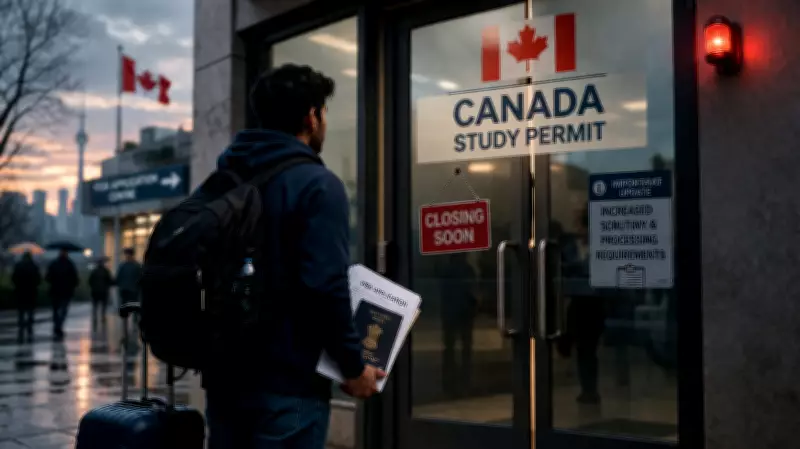
Canadian Audit Exposes Troubling Contradictions in Fast-Track Student Visa Program
A comprehensive government audit has uncovered significant contradictions within Canada's international student system, revealing that a fast-track visa route dominated by Indian applicants continued receiving exceptionally high approval rates despite mounting internal concerns about fraud, weak oversight, and "non-genuine students." The Student Direct Stream (SDS) program, designed as an expedited pathway for qualified applicants, became overwhelmingly populated by Indian nationals even as Canada's own risk assessment systems flagged serious integrity concerns.
Explosive Growth and Warning Signs
The Office of the Auditor General of Canada documented a dramatic 121 percent increase in study permit applications between 2019 and 2023, soaring from approximately 426,000 to 943,000 applications. Even before recent government clampdowns, internal reviews from 2023 had identified multiple pressure points including integrity risks, student vulnerability, and concerning lack of diversity within the international student population. India emerged as the central character in this unfolding narrative, accounting for 45 percent of Canada's international students in 2022.
The audit specifically criticizes Immigration, Refugees and Citizenship Canada (IRCC) for being slow to respond to identified integrity concerns within the SDS program. Despite India being assigned a high-risk profile by the department's own assessment units, applications through this route received what the audit describes as a "light touch" eligibility review.

Staggering Statistics Reveal Systemic Issues
The numbers tell a compelling story of systemic imbalance:
- 96 percent of SDS approvals in 2022 went to Indian nationals
- This figure remained at 96 percent in 2023
- Even in 2024, Indian nationals still received 87 percent of SDS approvals
Remarkably, approval rates for Indian nationals processed through SDS actually increased from 61 percent in 2022 to 98 percent in 2024, despite the department having identified integrity risks in SDS as early as 2022 and flagging the stream's targeting by "non-genuine students" by August 2023.
Why SDS Became an India-Heavy Corridor
Canada designed the Student Direct Stream as an expedited route for legal residents of 14 countries who could meet stringent upfront conditions including full first-year tuition payment, a Guaranteed Investment Certificate, qualifying language scores, and comprehensive supporting documentation. The theoretical bargain was straightforward: more paperwork upfront for faster processing later.
This eligibility framework aligned perfectly with a segment of Indian applicants who could front-load financial proof and documentation in exchange for accelerated processing. India was already Canada's largest international student source market outside the SDS stream, with the number of Indian study permit holders doubling from 218,522 in 2019 to 427,083 in 2023.
The fundamental problem emerged not from speed itself, but from a system that moved quickly while leaning too heavily on one stream, thereby compromising security protocols.
Warning Signs Ignored Despite Clear Evidence
The audit reveals that IRCC identified integrity concerns in SDS but failed to implement meaningful scrutiny despite clear warning signs. Three separate reports identified 800 approved study permits issued between 2018 and 2023 where applicants had used fraudulent documentation or misrepresented information to gain Canadian entry. Alarmingly, 541 of these permits (68 percent) had been approved under the Student Direct Stream.
In 710 documented cases, applicants claimed to have studied at overseas institutions that risk assessment units later discovered were either non-existent or effectively operated as qualification mills for immigration purposes. Despite departmental policies allowing post-approval action including file alerts, investigation of third-party involvement, and even revocation of immigration status, the department took no action in any of the 800 identified cases.

The consequences were significant: by the audit period's conclusion, 92 percent of these study permit holders had either already been approved or were awaiting decisions on other immigration permits, including permanent residence applications.
Genuine Indian Students Face Collateral Damage
When governments allow profitable immigration routes to expand rapidly while overlooking systemic issues, eventual tightening often affects legitimate applicants disproportionately. This reality now confronts genuine Indian students who arrive with proper documentation and honest intentions but find themselves navigating a system made more suspicious and difficult by previous abuses.
The dramatic shift is evident in recent statistics: India's share of visas issued to new international students plummeted to 8.1 percent by September 2025, down from 51.6 percent in 2023 and 33.6 percent in 2024. While officially framed as diversification, this sharp decline suggests institutional recoil from previous over-reliance on one source country.
This bureaucratic correction creates challenging conditions for legitimate applicants who now face increased documentation requirements, heightened skepticism, longer processing times, and visa officers approaching files with reduced generosity. Canada leaned too heavily on one stream, responded too slowly to identified risks, and is now implementing corrections after allowing systemic issues to develop unchecked.
The ultimate irony lies in Canada's original marketing approach: the country promoted not just education but a sequence of classroom experience followed by work opportunities and potential permanent residency. This promise attracted substantial numbers of Indian students before integrity concerns, fraud findings, and systemic weaknesses prompted institutional nervousness and procedural tightening.
Honest Indian students now find themselves navigating the aftermath of this systemic failure, potentially paying the price for abuses they didn't commit while facing increased barriers in what was once a welcoming educational destination.





