Viral Protest Clip Ignites Debate Over Indian-American Cultural Identity
A street interview from a recent protest in the United States has gone viral, triggering widespread online reactions and drawing sharp criticism from conservative commentator Dinesh D'Souza. The controversy centers on what D'Souza describes as the "wrong" kind of cultural assimilation among some Indian Americans, sparking a heated discussion about identity and integration.
The Viral Exchange at the "No Kings" Protests
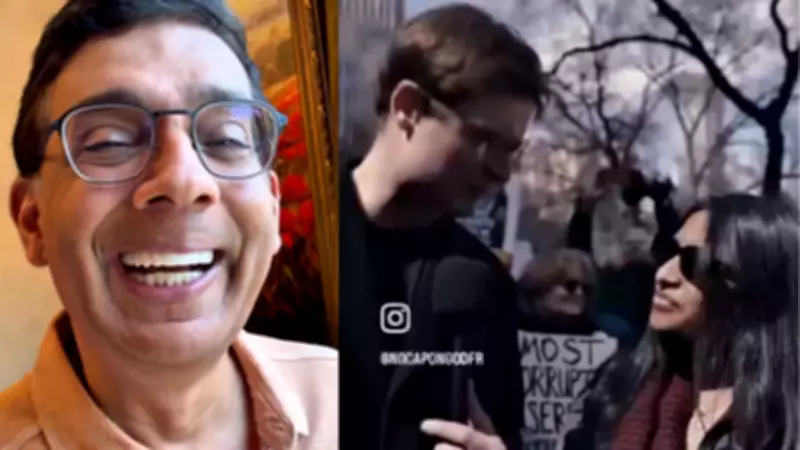
The clip originated from the "No Kings" protests held across parts of the United States, which were organized to oppose former President Donald Trump's foreign policy, particularly tensions related to the Strait of Hormuz. In the video, a street interviewer poses a sarcastic question to a protester, asking if it is "a little bit homophobic that we're so focused on the straits of Hormuz and not the gays of Hormuz." The woman responds affirmatively, stating, "Yes, I agree. Yes, for sure... They're going for the straits of Hormuz but they're not willing to protect the gays of Hormuz. That's not cool."
Notably, the phrase "gays of Hormuz" is fictional, a playful twist on the strategic waterway's name, yet the protester appears to treat it as a genuine issue, even attempting to provide a historical explanation about discrimination. This bizarre exchange quickly captured public attention and spread across social media platforms.

Dinesh D'Souza's Commentary on Assimilation
Indian-American commentator Dinesh D'Souza seized on the viral clip to voice his concerns about cultural identity. Posting on X, he wrote, "Even I have a problem with certain Indians, and not because they haven't assimilated.... It's because they HAVE assimilated—to the wrong America." In a split-screen video where the viral footage played alongside his remarks, D'Souza elaborated further.
He stated, "So someone at the No Kings protests goes to this activist and poses a very 'straightforward' question. You know, until recently, we Indian Americans of this country have had a reputation of being somewhat smart. People like me have worked hard to earn that reputation. We sometimes think of the immigrants and wish they would assimilate.... but you know what? This young woman has assimilated. She has assimilated into America, but which America? Not our America, not traditional America. She is assimilated to the America she knows. The media, the elites, the progressive, that's the America she knows, and she has picked up all of her cliches, all of its prejudices."
Online Reactions and Broader Context
The viral clip and D'Souza's comments have sparked diverse reactions online. Some internet users questioned whether the woman in the video is even of Indian origin, as her ethnicity remains unconfirmed, while others defended her, arguing that she was expressing empathy, albeit in a confused context. Critics called out D'Souza for his remarks, pointing to his own immigrant background and accusing him of hypocrisy.
Beyond the cultural debate, the Strait of Hormuz remains a critical geopolitical hotspot. As one of the world's most vital energy chokepoints, approximately one-fifth of global oil shipments pass through it. Current tensions between the United States and Iran have raised concerns about potential disruptions, military posturing, and threats to shipping lanes. Any escalation could significantly impact global oil prices and international trade, underscoring the serious economic and security consequences at stake.
This incident highlights the complex intersections of cultural assimilation, political activism, and global affairs, prompting reflection on how immigrant communities navigate identity in a polarized environment.