

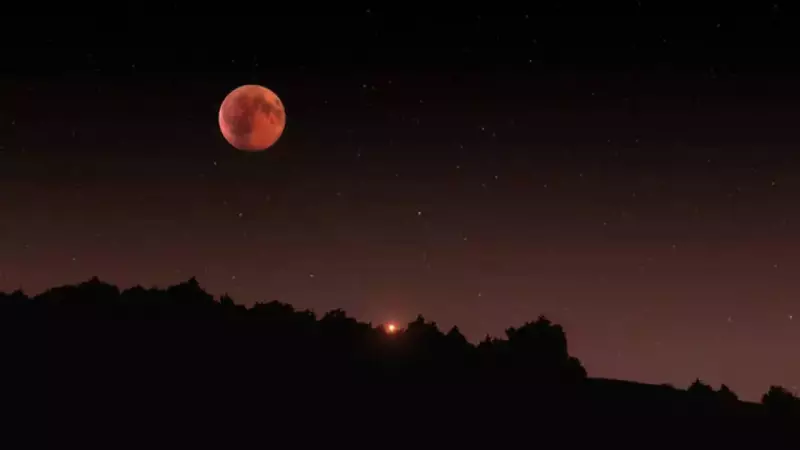
In the quiet rhythm of our days, certain celestial events capture our gaze without fanfare. The full moon is one such phenomenon. It doesn't arrive with loud announcements but simply appears, round and luminous, commanding attention for a few nights before fading back into its monthly cycle. For some, it marks festivals; for others, it influences tides or simply offers a moment of nocturnal beauty. While astronomers chart its path with exact precision, for most of us, it remains a serene, monthly punctuation in the sky. As we look ahead to 2026, this timeless rhythm continues, its dates and hours shifting slightly but its dependable cycle unwavering.
The Science of the Full Moon: What Causes It?
A full moon occurs during a specific celestial alignment. It happens when the Sun, Earth, and Moon form a nearly straight line, with our planet positioned squarely in the middle. During this alignment, the side of the Moon facing Earth is completely illuminated by sunlight. What we see is not the Moon's own light but sunlight reflected off its dusty surface. On occasion, a faint glow can be seen on the darker portion of the Moon's face. This subtle light, known as earthshine, is sunlight that has bounced off our planet's oceans and clouds onto the lunar surface.
The Moon takes approximately 29.5 days to complete one full cycle of phases, from new moon to full moon and back again. This period, called a synodic month, is why we typically experience one full moon each calendar month. However, because our Gregorian calendar months are not perfectly synced with this lunar cycle, the dates of the full moon drift gradually throughout the year. This occasional misalignment is also what leads to a rare but fascinating event: two full moons occurring within a single calendar month.

Full Moon Calendar 2026: Complete List for India (IST)
If you're planning by the lunar calendar or are just a keen moon-gazer, here is the complete schedule for the full moons of 2026, all times adjusted for Indian Standard Time (IST). The cycle begins shortly after the last full moon of 2025, which falls on December 4.
The next full moon of 2026 will appear on 3 January 2026 at 3:33 pm IST.
- 3 January 2026 at 3:33 pm
- 2 February 2026 at 3:39 am
- 3 March 2026 at 5:08 pm
- 2 April 2026 at 7:42 am
- 1 May 2026 at 10:53 pm
- 31 May 2026 at 2:15 pm
- 30 June 2026 at 5:27 am
- 29 July 2026 at 8:06 pm
- 28 August 2026 at 9:48 am
- 26 September 2026 at 10:19 pm
- 26 October 2026 at 9:42 am
- 24 November 2026 at 8:23 pm
- 24 December 2026 at 6:58 am
Does Every Month Have a Full Moon?
While most months do feature one full moon, the imperfect match between our calendar and the lunar cycle means the answer isn't always yes. Some calendar months are long enough to contain the entire 29.5-day lunar cycle, plus a little extra. When this happens, we can witness two full moons in that same month. The second of these two full moons is popularly termed a Blue Moon. It's important to note that this is purely a quirk of our human-made calendar and does not signify any actual change in the Moon's color or behavior.
So, as 2026 unfolds, you can use this guide to look up and appreciate this quiet, consistent celestial clock. Whether for spiritual observance, scientific curiosity, or simple wonder, the full moon continues to be a shared point of connection between the Earth and the cosmos.






