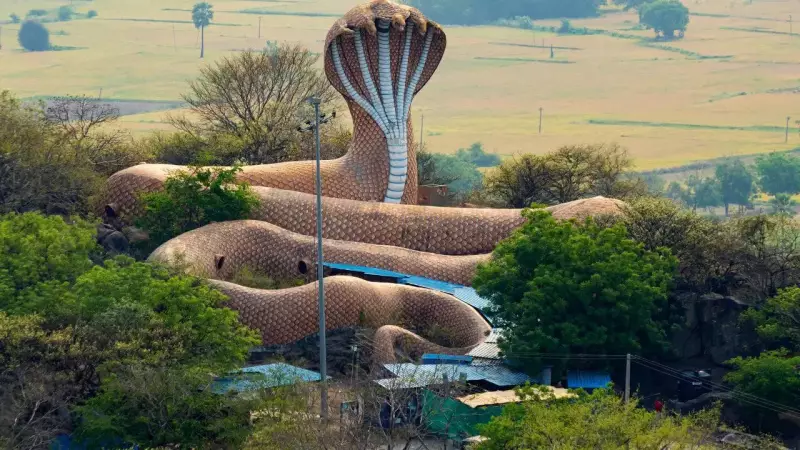
In the ancient rock layers of western India, scientists have uncovered a window into a lost world of intense heat, shifting continents, and colossal reptiles. A remarkable fossil discovery in Gujarat has captured global scientific attention, providing evidence of an extraordinarily large snake that slithered across the landscape approximately 47 million years ago, during the Eocene epoch.
Unearthing a Prehistoric Giant in Gujarat
The evidence, centered on well-preserved vertebrae found in early Eocene sedimentary deposits, points to a snake of immense size. For paleontologists, vertebrae are among the most informative bones for snakes, as their dimensions strongly correlate with the animal's overall size and build. A detailed anatomical study identified this ancient creature as a member of the extinct Madtsoiidae family, a group notorious for evolving some of the largest snakes in Earth's history.
The research, published in Scientific Reports, highlights that the Gujarat specimen's vertebrae possess outstanding features compared to other known madtsoiids. The bones are not only long but also indicate a broad, muscular body, challenging the simplistic notion that only length matters when judging a serpent's might. This find suggests that different regions of the ancient world, including India, were home to their own unique species of gigantic snakes, distinct from famous examples like Titanoboa of South America.

The Hothouse World That Fed the Giants
The Eocene period was one of the hottest chapters in recent geological history, with tropical climates blanketing vast areas of the planet and polar regions largely free of ice. This steamy global environment was crucial for the evolution of giant, ectothermic (cold-blooded) reptiles like snakes. Consistent, high temperatures allowed them to grow rapidly and to enormous sizes, as the metabolic constraints of a cooler climate were absent.
Analysis of geological and fossil plant data from Gujarat paints a picture of a lush, dynamic landscape crisscrossed by rivers, deltas, and dense forests. This ecosystem would have teemed with potential prey, including early mammals, large fish, and other reptiles. In such an environment, a massive snake could reign as a top predator, exerting a substantial influence on the entire food chain and reshaping predator-prey relationships through its hunting prowess.
A Serpentine Clue to Continental Journeys
Perhaps the most profound implication of the "Gujarat salt swamp serpent" lies not in its size alone, but in the story it tells about Earth's ancient geography. Fossils of madtsoiid snakes have been discovered across several southern continents—Africa, South America, and Australia—which were once united in the supercontinent Gondwana.
India was originally part of Gondwana before it broke away and embarked on a long northward drift, eventually colliding with Asia. The presence of a giant madtsoiid in Eocene India, at a time when the subcontinent was likely an isolated landmass, raises fascinating questions. It suggests these giant reptiles were widespread before the continents fully separated, or that migratory pathways via land bridges and island chains allowed them to disperse. This fossil is thus a tangible piece of evidence in the puzzle of continental drift and India's unique biogeographic journey.
The discovery underscores how a single fossil can illuminate multiple facets of deep time—from the ecology of a hot-house Earth and the evolution of apex predators to the dramatic plate tectonic movements that shaped the modern world. Researchers continue to piece together these ancient systems, showing how climate and geography conspired to create a world where giants could thrive.