

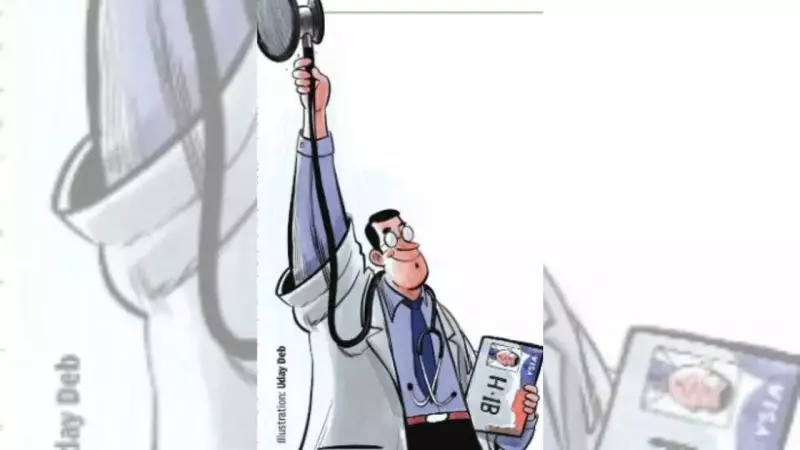
US H-1B Visa: Indian Doctors Top Salary Charts, Not Tech Workers
People often link the H-1B visa program with technology professionals. However, a recent study shows a different story. Medical practitioners now earn the biggest paychecks among foreign workers in the United States. This shift comes as America faces an ageing population and a severe shortage of healthcare staff.
Specialty Physicians Dominate High-Paying Roles
Manifest Law, a US immigration law firm, conducted the study. They used data from the US Department of Labor. The report found that specialty physicians lead the foreign worker salary spectrum. These include cardiologists, anaesthesiologists, radiologists, and neurologists.
Medical roles occupy the top 11 positions among the 15 highest-paid H-1B occupations. Several specialties report median wages well above $300,000. That is approximately Rs 2.7 crore. In contrast, the highest-paid non-medical roles earn between $100,000 and $200,000. Lawyers, computer systems managers, and finance managers fall into this category.

The report stated that five medical occupations have median H-1B wages exceeding $300,000. Some even cross $400,000. A growing demand within the US healthcare system drives these high salaries. Physician shortages, an ageing population, and long domestic training pipelines contribute to this demand.
Indian Doctors Shape the Upper End
Indians are commonly associated with software engineering and IT services in the US. Yet, Indian-origin doctors increasingly shape the upper end of the H-1B wage spectrum. Haley Davidson, the report's author, explained this trend. She highlighted the specialised medical field as a key area.
H-1B wages vary sharply by geography. The US West Coast records salaries well above the national median. California, Washington state, and Oregon stand out. The national median H-1B wage is $123,828.
At the metropolitan level, technology hubs like San Jose and San Francisco top the list among large cities. However, smaller metropolitan areas often pay even more. These areas are frequently situated far from tech corridors.
Small Cities Offer Big Paychecks
Several small metropolitan areas with populations under 350,000 significantly outpace major tech hubs. Acute healthcare demand drives this phenomenon. Cities such as Parkersburg and Beckley in West Virginia report median H-1B wages exceeding $315,000. Jacksonville in North Carolina and Lake Havasu City in Arizona also show high figures.
Dr Bharath Naravetla, a neurologist, commented on this trend. He said healthcare demand concentrates in rural areas rather than any particular state. Rural locations often pay higher salaries. Alaska pays the highest salaries in his field. Supply and demand purely dictate these rates.
Experience and Specialty Determine Income
Within medical fields, experience and practice setting play a decisive role. Dr Suresh Reddy, an interventional radiologist, shared insights. Doctors typically reach top compensation brackets five to ten years after completing training.
There is exceptionally strong demand for interventional radiology across the US. With experience, academic practice typically pays between $450,000 and $550,000 per year. Private practice can range from $600,000 to $900,000 annually.
However, Reddy cautioned about H-1B visa limitations. The visa restricts job mobility and location flexibility. Many physicians accept less desirable positions or locations until they secure permanent residency or citizenship.
Indian Medical Graduates Drawn to US
Despite constraints, financial and professional rewards continue to attract Indian medical graduates. Dr Ashok Kondur, an interventional cardiologist, described his journey. He graduated from Osmania Medical College in 1998. He moved to the US for postgraduate training.
Indian medical education provided a strong clinical base. US training focused on evidence-based medicine and advanced technology. Interventional cardiology is among the highest-paid medical specialties in the US. Salaries benchmark against standards set by the Medical Group Management Association.

Long and Arduous Path to US Practice
The path to practising medicine in the US remains long, expensive, and uncertain. Dr Ameen B R, a general physician from Hyderabad, shared his experience. He is preparing to pursue further training in the US after completing his MBBS in India.
Candidates must clear the US Medical Licensing Examination. This exam is tougher than Indian medical exams. It has three steps, each requiring six to eight months of preparation. The process is financially draining too. Many candidates give up after one or two steps.
The residency application process is highly competitive. Aspirants often apply to 180 to 200 universities. They pay $18 to $20 per application. Most receive only four or five interview calls. It is easier to get admission in rural areas. The H-1B pathway is also smoother there.
Demand for Foreign-Trained Specialists Grows
Demand for foreign-trained specialists shows no signs of slowing. The Association of American Medical Colleges projects a shortage of up to 86,000 specialist physicians by 2036. Specialty physicians will remain central to H-1B demand in healthcare.
Underserved and rural regions particularly need these professionals. Population growth and a rapidly expanding over-65 demographic increase reliance on H-1B medical professionals. A significant portion of the US physician workforce is nearing retirement.
These roles are difficult to automate. They face long domestic training pipelines. Foreign-trained specialists will continue to play a critical role in maintaining healthcare capacity. Hospitals and health systems that struggle to attract US-trained providers especially depend on them.





