

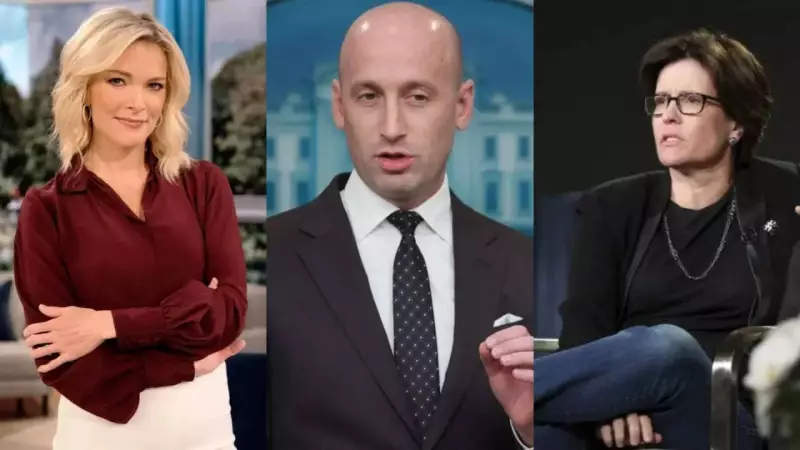
Megyn Kelly vs Kara Swisher: Social Media Storm Over Stephen Miller Nazi Comparison
A fierce social media confrontation has erupted this week between two prominent American media personalities, conservative commentator Megyn Kelly and tech journalist Kara Swisher, centering on a highly controversial historical analogy involving former Trump administration adviser Stephen Miller. The clash has ignited intense debates across political lines about the boundaries of acceptable rhetoric in public discourse.
The Spark That Ignited the Firestorm
The controversy originated from a video clip of the Pivot podcast, where Kara Swisher, alongside co-host Scott Galloway, delivered a scathing critique of Stephen Miller's influence on immigration policy. In her commentary, Swisher drew parallels between Miller and historical figures associated with grave human rights abuses, specifically mentioning Heinrich Himmler, a key architect of the Holocaust, and Karl Bendetsen, who orchestrated Japanese-American internment camps during World War II.
Swisher asserted that Miller would "go down in history as evil" and claimed he had "blood on his hands," framing her comparison as a moral indictment of immigration enforcement decisions she views as deeply problematic. Her broader argument focused on what she perceives as the ethical responsibilities of policymakers amid ongoing national scrutiny of federal immigration actions.

Megyn Kelly's Explosive Response
Megyn Kelly, host of The Megyn Kelly Show, reacted with immediate outrage to Swisher's comments, characterizing them as dangerously extreme and potentially life-threatening. In an early Wednesday morning tweet that rapidly went viral, Kelly wrote: "This is SICK. She's trying to get @StephenM killed. Why else would you say he's Himmler? Deranged and so far beyond the pale. We can't become immune to it."
Kelly amplified her condemnation by accusing Swisher of employing rhetoric so incendiary that it could endanger Miller's safety, framing the comparison as crossing fundamental boundaries of civil political discourse. Her response positioned the controversy within broader conservative concerns about what they view as dehumanizing language directed at political opponents from progressive commentators.
Social Media Erupts in Polarized Reactions
The platform X, formerly known as Twitter, became the primary battleground for this dispute, with reactions splitting sharply along political lines. Conservative users widely praised Kelly's defense of Miller, sharing her post extensively and condemning Swisher's comments as irresponsible and potentially violent in tone. Many framed the incident as evidence of what they perceive as a double standard in how political rhetoric is evaluated when targeting conservative versus liberal figures.
Conversely, numerous commentators and journalists criticized Kelly's characterization of Swisher's remarks, arguing that while hyperbolic, the comparison was not literally advocating physical harm but rather using historical analogies to emphasize perceived moral failures in policy. One user responded: "Go f*** yourself @megynkelly You are as disgusting as ever. And it's a very fair comparison." Another commented: "Dems are losing their tiny minds everywhere! Republicans must be doing a great job!"
The Central Figure: Stephen Miller's Polarizing Legacy
At the heart of this storm stands Stephen Miller, who served as a senior policy adviser in the Trump White House and is widely recognized as the architect of hard-line immigration policies. Miller's political philosophy has been described as far-right with a strong emphasis on immigration restriction, making him a deeply polarizing figure in American politics.
Supporters view Miller as a principled conservative policymaker committed to national sovereignty, while critics characterize his rhetoric and policy impact as dangerously exclusionary and extremist. This fundamental polarization over immigration, national identity, and federal enforcement authority provides the combustible backdrop for disputes like the Kelly-Swisher confrontation.

Broader Implications for Political Discourse
This clash transcends a mere disagreement between two media personalities, reflecting deeper tensions in American public discourse about how historical analogies should be employed in political criticism. Critics of Swisher's approach argue that invoking figures associated with atrocities like Heinrich Himmler crosses an ethical line, transforming policy disagreements into existential moral battles that can incite dangerous polarization.
The incident underscores how rhetoric that blends sharp policy critique with symbolic historical comparison is interpreted through distinctly partisan lenses, contributing to the deepening divisions characterizing contemporary political debate. Furthermore, it highlights the influential role media figures like Kelly and Swisher play in shaping public opinion and intensifying partisan narratives, often becoming central actors in the very controversies they comment upon.
As reactions continue to unfold, observers are monitoring several developing aspects: potential further exchanges between media figures across the political spectrum, evolving standards for rhetorical boundaries in commentary about controversial policies and figures, and possible internal discussions within media organizations about appropriate guidelines for historical analogies, particularly those involving atrocities. The Kelly-Swisher confrontation serves as a potent case study in how social media amplifies and accelerates political conflicts in the digital age.





