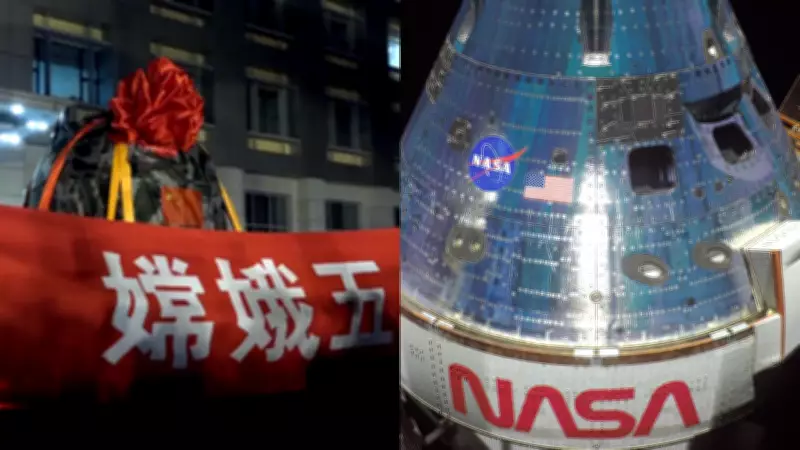
The Moon Emerges as New Frontier in Global Space Competition
In a remarkable resurgence of cosmic ambition, the Moon has once again captured the world's imagination, but this time with a crucial difference. The focus has shifted from mere exploration to establishing permanent human presence and occupation. This renewed interest has been dramatically ignited by NASA's groundbreaking Artemis II mission, representing the first crewed lunar flight in over fifty years. Simultaneously, China has announced its bold plan to land astronauts on the Moon by 2030, creating what many analysts are calling the twenty-first-century space race.
NASA's Artemis Program: Pioneering Sustainable Lunar Settlement
The Artemis program stands as NASA's visionary long-term initiative designed to create sustainable human habitats on the Moon. The landmark Artemis II mission, launched on April 1st, 2026, successfully transported four astronauts on an unprecedented journey around the Moon, taking them farther from Earth than any humans in history. This mission served as a critical test bed for evaluating life support systems and crew performance in the harsh environment of deep space.
NASA officials emphasize that the Artemis missions serve a dual purpose: establishing human presence on the Moon while simultaneously preparing for future Mars exploration. The successful execution of these missions will gradually build the necessary infrastructure to support sustained human life on the lunar surface, marking a significant leap forward in space exploration capabilities.

China's Ambitious 2030 Lunar Landing Strategy
Meanwhile, China has embarked on an equally ambitious path with its Chinese Lunar Exploration Program, targeting a crewed Moon landing by 2030. The China National Space Administration has already achieved remarkable milestones, including becoming the first country to retrieve lunar samples from the Moon's far side through its Chang'e-6 mission to the South Pole-Aitken basin in June 2024.
China plans to launch two additional robotic missions, Chang'e-7 and Chang'e-8, before 2030 to gather crucial data about the lunar regions where it intends to establish human presence. The country is developing advanced technological systems including Long March-10 rockets, Mengzhou crewed spacecraft, and Lanyue lunar landing craft to enable safe transportation of astronauts between Earth and the Moon.
These achievements form part of China's broader strategy to construct the International Lunar Research Station by 2035. While Chinese officials avoid framing their efforts as a "space race," analysts note that the country views technological advancements in space capabilities as essential for achieving strategic dominance in this critical domain.
The New Space Race: Global Implications and Resource Competition
The current lunar exploration revival represents a fundamental shift from symbolic missions to sustainable presence and resource utilization. Unlike the Cold War era competition between two superpowers, today's space race involves multiple nations and even private companies, creating a more complex geopolitical landscape.
NASA has initiated the Artemis Accords to promote international collaboration, establishing principles for transparent and peaceful space exploration. Concurrently, China is developing the International Lunar Research Station with its partners, creating alternative frameworks for future cooperation. The Moon's southern pole has emerged as particularly significant due to the presence of water ice, making it a valuable resource for future missions and potential settlements.
With NASA achieving successful lunar landings and China targeting 2030 for its crewed mission, the coming decade promises to be transformative for space exploration. This competition is driving rapid technological innovation while raising important questions about international cooperation, resource allocation, and the future of human presence beyond Earth.