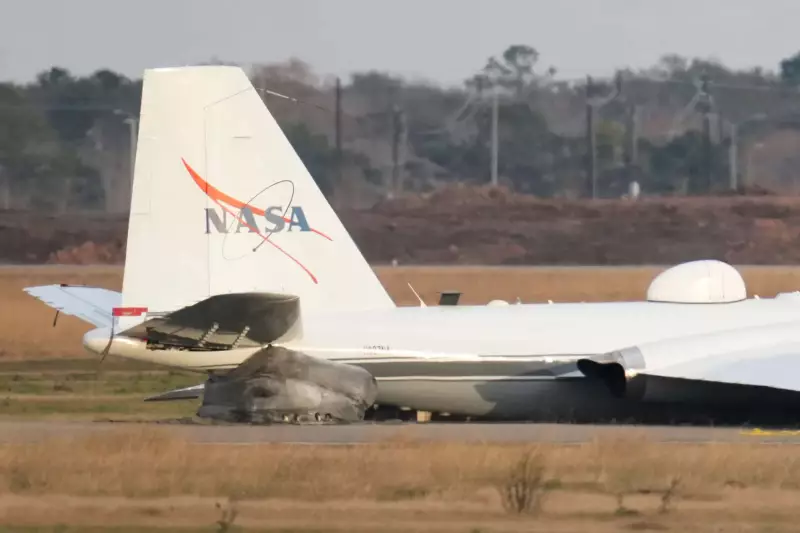
A NASA research aircraft was forced to execute a dramatic emergency landing in Texas on Tuesday after experiencing a critical mechanical failure that prevented its landing gear from deploying properly. The high-altitude plane touched down at Ellington Airport, located near Houston, sliding along the runway on its belly in a tense maneuver that captured widespread attention.
Dramatic Footage Captures Landing Incident
Videos circulated on social media platforms showed alarming scenes of sparks, flames, and smoke emanating from beneath the aircraft as it gradually came to a halt on the tarmac. Despite the visually intense situation, NASA promptly confirmed that both crew members aboard the aircraft landed safely and no injuries were reported among personnel or on the ground.
NASA Confirms Mechanical Issue and Launches Investigation
The space agency acknowledged that a mechanical problem was responsible for the landing gear malfunction and stated that a thorough investigation will be conducted to determine the exact cause. This incident highlights the inherent risks associated with advanced aerial research operations, even for an organization with NASA's extensive experience and safety protocols.

About the NASA WB-57 Research Aircraft
The aircraft involved was identified as a NASA WB-57, a specialized high-altitude research plane designed to carry two crew members on scientific missions. This particular model is engineered to operate at extremely high altitudes, capable of remaining airborne for more than six hours at a time to facilitate various atmospheric and space research projects.
Emergency Response and Historical Context
Local television footage from the scene depicted the aircraft stationary on the runway with its cockpit hatch open, surrounded by fire trucks and emergency response teams working diligently to secure the area. The WB-57 has been an integral part of NASA's scientific fleet since the 1970s, participating in numerous research missions that contribute to our understanding of Earth's atmosphere and beyond.
This emergency landing serves as a reminder of the challenges faced in aviation research, even with well-established aircraft like the WB-57. NASA's commitment to safety and investigation will likely yield important insights that could influence future aircraft maintenance and operational procedures for similar high-altitude research platforms.