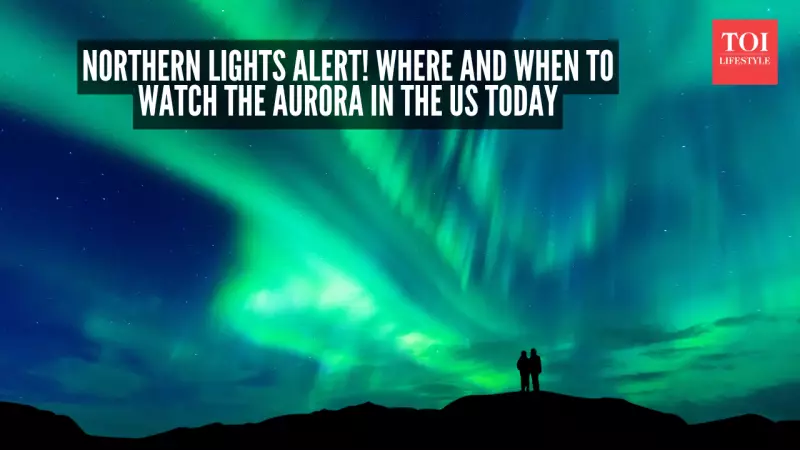
Northern Lights Could Grace US Skies on Sunday Night
If you have been searching for a compelling reason to venture outdoors and gaze upward, Sunday night might just deliver. A new aurora forecast indicates the Northern Lights could extend farther south than typical, potentially granting residents in parts of the United States a glimpse of the sky's most celebrated light spectacle. This opportunity hinges on cooperative conditions and clear skies free from cloud cover.
Where the Aurora Might Appear Across the US
The National Oceanic and Atmospheric Administration (NOAA) released its latest viewing line, suggesting aurora activity may become visible late Sunday night across numerous northern states. NOAA's forecast projects the aurora could stretch across states bordering the US and Canada.
- This includes sections of Washington, Idaho, Montana, and South Dakota.
- The entire state of North Dakota falls within the potential viewing zone.
- In the Midwest, visibility might span most of Minnesota, northern Wisconsin, and northern Michigan.
- Northern Maine could also witness the lights, alongside most of Alaska where aurora sightings occur more frequently.
NOAA cautions that aurora forecasts can shift rapidly due to solar activity and local weather patterns. Visibility remains uncertain even within the predicted areas.

Expert Tips for Optimal Northern Lights Viewing
NOAA experts provide clear recommendations for those hoping to see the aurora. Heading north toward the magnetic north pole improves your chances significantly. Escaping city lights and artificial illumination is crucial. Find a location offering a clear, unobstructed view of the northern horizon.
Timing plays a vital role. Auroras generally reach peak activity around midnight. NOAA advises planning your viewing between 10 p.m. and 2 a.m. local time when the lights often shine brightest.
Capturing the Aurora with Your Smartphone
You do not require professional photography equipment to document the Northern Lights. Most contemporary smartphones can capture impressive aurora images. The essential steps involve turning off the flash and, if available, shooting in RAW format. Using a tripod stabilizes your phone for longer exposure shots.
iPhone users should start with the standard lens and activate Night mode. Android users might achieve better results by switching to Pro mode and manually adjusting exposure settings.
The Science Behind the Northern Lights
The Northern Lights originate far from Earth on the Sun's surface. Solar storms eject enormous clouds of electrically charged particles that travel millions of miles through space. Some particles eventually reach our planet.
Earth's magnetic field deflects most particles, but some become trapped and funneled toward the north and south poles where aurora activity concentrates. Collisions with atmospheric gases produce the mesmerizing light display.
"These particles then slam into atoms and molecules in the Earth's atmosphere and essentially heat them up," explains Royal Observatory astronomer Tom Kerss. "We call this physical process 'excitation', but it's very much like heating a gas and making it glow."
Earth's magnetic field lines shape the aurora's characteristic waves and curtain-like formations. The lowest part of an aurora typically appears approximately 80 miles above Earth's surface, though the upper reaches can extend thousands of miles into space.