

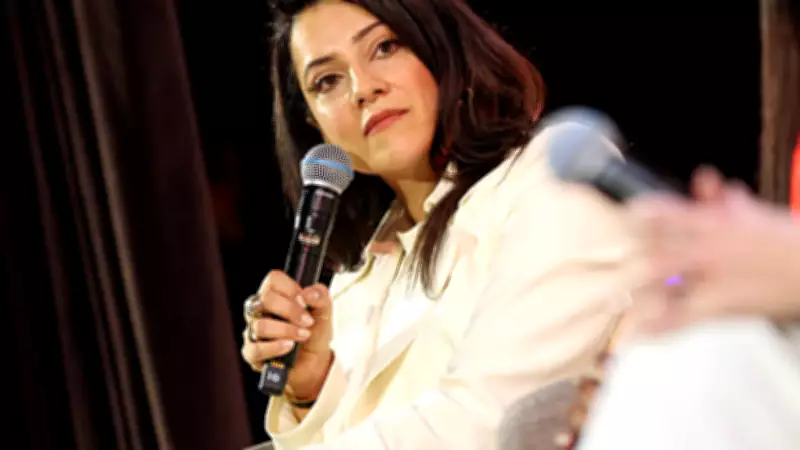
Reshma Saujani Sounds Alarm on Systemic Bias and Masculinity Crisis in America
For years, Reshma Saujani, the founder of Girls Who Code, has been receiving disturbing accounts from young women entering the workforce. One girl shared, "I did an interview, and instead of getting the job, I got asked on a date," while another recounted, "I did an interview, and he was on his treadmill." Saujani emphasizes that these incidents are not isolated but reflect a deeper, uncomfortable pattern of systemic bias against women that persists across society.
A Broader Crisis of Masculinity and Its Impact
In recent interviews and public appearances, including discussions highlighted by TIME, Saujani has issued a stark warning. She asserts that the United States is facing what she terms a broader crisis of masculinity, which she believes is profoundly shaping workplaces, politics, and everyday life for women. This moment, in her view, has created "dangerous times to be an American woman."
During a notable event, Saujani elaborated, "Men are lonelier, you know. They are not going to college at the same rates as women. There's a systemic epidemic. But part of what's happened is there are folks on the far-right that have said 'the reason why you don't have a job, the reason why you're depressed, is because you see women over there? We gave them too much power. And the way to lift you up is I'm going to pull them down.'"

She continues, "We are living through one of the most dangerous times it's ever been to be an American woman." Saujani focuses particularly on the erosion of reproductive rights, suggesting that such actions can lead to the disenfranchisement of women, stripping away freedoms from the deep-rooted shackles of patriarchy embedded in societal structures and systems.
Building Movements for Girls and Mothers
Saujani has long positioned herself at the forefront of campaigns to close gender gaps in technology and the workplace. She founded Girls Who Code, a global movement dedicated to increasing the number of women in computer science, and later launched Moms First, a nonprofit advocating for mothers and working families.
Both initiatives target structural barriers that continue to limit women’s opportunities, from the underrepresentation of girls in tech education to the lack of affordable childcare. Her advocacy recently intersected with policy when she stood alongside New York Governor Kathy Hochul and New York City Mayor Zohran Mamdani during the announcement of a $1.7 billion plan to deliver universal childcare for children under five.
This proposal reflects a key argument Saujani has made repeatedly: that economic equality for women cannot exist without addressing childcare and caregiving responsibilities, highlighting the interconnectedness of social support and financial empowerment.
Recognition and Global Influence
Saujani’s work has drawn widespread recognition across business, technology, and advocacy circles. In February 2026, she was named one of TIME’s Women of the Year, a prestigious recognition of leaders shaping global conversations about equality and social change.
Over the years, her achievements have been celebrated on numerous influential lists, including:
- Fortune’s World’s Greatest Leaders
- Fortune 40 Under 40
- WSJ Magazine Innovator of the Year
- Forbes Most Powerful Women Changing the World
- InStyle’s Woman of Impact
- Fast Company’s 100 Most Creative People
She also received the Harold W. McGraw, Jr. Prize in Education for her contributions to transforming education for girls, underscoring her impact beyond advocacy into tangible educational reform.
The Moment That Led to Girls Who Code
The roots of Saujani’s work in technology can be traced back to her political campaign years ago. During an interview with Yale University, she explained how visiting schools during her campaign revealed a troubling observation: "I visited schools and classrooms along the campaign trail. And though I lost the election, something about my time visiting those schools stuck with me, the lack of girls in computer science classrooms…"

That observation ultimately led her to launch Girls Who Code, an organization that has since reached hundreds of thousands of girls worldwide through coding education and mentorship, fostering a new generation of female technologists.
Early Life Shaped by Refugee Parents
Reshma Saujani was born on November 18, 1975, and is an American lawyer, politician, and civil servant. Her family history, however, stretches far beyond the United States. In an interview with TIME, Saujani reflected on her parents’ journey to America and how it shaped her outlook.
"My parents came [to the U.S.] as refugees. I think about this a lot, especially with what's happening in the country right now. But both my mother and my father were born in Uganda. [My family was there] for two generations, and they were expelled, with 90 days notice. And growing up in a family where everything can be taken away from you in a second shapes you."
The expulsion of Asians from Uganda forced many families, including hers, to start over elsewhere. That experience, she says, shaped her understanding of opportunity and instability. She has often spoken about feeling indebted to the American dream, noting, "When you come to this country with nothing like my parents did, with $12 in their pockets, and you're taking classes to learn the language, and the Catholic Church has taken you in to feed you and shelter you, you think a lot about, like, how do you get into the middle class?"
From Politics to Advocacy
Before becoming known for her nonprofit work, Saujani first entered public life through politics. In 2009, she ran against Carolyn Maloney for the US House of Representatives seat from New York’s 14th congressional district, becoming the first Indian American woman to run for Congress. Although she lost the race, the campaign proved transformative for her future work.
In 2013, she ran again, this time as a Democratic candidate for New York City Public Advocate, ultimately finishing third in the primary. Those experiences exposed her to education inequalities and workplace barriers that would later shape the missions of Girls Who Code and Moms First.
In recent years, Saujani’s focus has expanded beyond technology education to include what she calls the "care crisis." As founder and CEO of Moms First, she argues that millions of working mothers are trapped between demanding jobs and a childcare system that is too expensive and inadequate. Through policy advocacy and public campaigns, she pushes for solutions such as paid leave and affordable childcare, asserting that economic equity cannot be achieved without supporting caregivers, particularly mothers who make up a large portion of the workforce.
Books, Podcast, and Reframing Midlife
Saujani has also amplified these ideas through writing and media. Her bestselling books PAY UP: The Future of Women and Work (And Why It’s Different Than You Think) and Brave, Not Perfect explore how societal expectations shape women’s careers and personal lives.
In 2024, she expanded into podcasting with My So-Called Midlife, produced by Lemonada Media. The show quickly entered Apple’s Top 10 podcast charts and was later named one of the best new podcasts of the year by TIME. Through the podcast, Saujani argues that midlife should not be seen as decline but as a period of reinvention—a theme that mirrors her own transition from politics to activism and public storytelling.
Life Beyond Activism
Away from her public work, Saujani lives in New York City with her husband, entrepreneur Nihal Mehta. Mehta co-founded the ad-tech startup LocalResponse and is now a co-founding partner at Eniac Ventures, a seed-stage venture capital firm. Saujani is a practicing Hindu, and the couple have two children.
Balancing family life with activism, Saujani continues to merge policy advocacy with accessible storytelling. Her inclusion in TIME’s 2026 Women of the Year list reflects the impact of her work, and her argument that meaningful economic reform can only happen when girls and women are fully included in the system shaping it, reinforcing her lifelong commitment to gender equality and social justice.





