

The Fading Promise: Indian-Americans Confront Rising Discrimination and Hinduphobia
In his seminal 1931 work The Epic of America, historian James Truslow Adams introduced a concept that would become a global aspiration: the "American Dream." Adams envisioned a society where life could be "better, richer and fuller for everyone," with opportunities determined by merit rather than birthright or social class. This powerful ideal has drawn millions to American shores, including generations of Indians seeking better economic prospects, educational opportunities, and social mobility.
The Historical Journey of Indian-Americans
The Indian migration to America began in earnest during the 19th century, accelerating dramatically throughout the 20th century. For many Indian immigrants, America represented the ultimate destination—offering urban living, substantially higher incomes, enhanced career prospects, and elevated social status back in their homeland. The pioneering journey saw Bhicaji Balsara, a Parsi entrepreneur, become the first Indian to obtain U.S. citizenship through naturalization in 1910.
The narrative of Indian-American success reached symbolic peaks with Satya Nadella's appointment as Microsoft CEO in 2014 and Sundar Pichai becoming Google CEO in 2015. What originated with Punjabi agricultural workers settling on the West Coast evolved into families investing substantial resources, often taking significant loans, to send their children to pursue the American Dream regardless of financial sacrifice.

The Political Landscape and Changing Climate
The presidency of Barack Obama (2009-2017) marked a high point for Indian-American political representation, with numerous community members appointed to senior administration positions. This era led some to humorously dub Obama the "first Indian-American president" given his administration's inclusivity toward the approximately three million strong community at that time.
The subsequent Trump administration (2017-2021) presented a more complex picture. Despite efforts to court Indian-American voters, Trump secured only about 16% of their vote in 2016, with support rising to approximately 28% by 2020 according to Asian American Voter Survey data. The Biden administration strengthened representation further by selecting Kamala Harris as vice presidential candidate in 2020, making her the first person of Indian descent to hold the office from 2021 to 2025.
Donald Trump's re-election in 2025 ushered in what he termed America's "Golden Age," yet for many Indian-Americans, the subsequent political and cultural environment has felt decidedly less welcoming and secure.
The Disturbing Reality of Contemporary Discrimination
A recent comprehensive survey conducted by the Carnegie Endowment for International Peace in partnership with YouGov reveals troubling developments. The Indian American Attitudes Survey (IAAS), which polled 1,000 Indian-American adults from the community of approximately 5.2 million, documents widespread experiences of bias, online racism, personal harassment, and discrimination.
The findings indicate that many respondents have altered their behavior—modifying speech patterns, changing attire, or limiting public participation—to avoid confrontation. Particularly alarming is the statistic that one in four Indian Americans report being subjected to racial slurs since the beginning of 2025. The report characterizes the United States as the "epicenter of anti-Indian digital racism," noting that much online hostility specifically targets Hindu symbols, traditions, and religious references.
The Specific Challenge of Anti-Hindu Sentiment
With Hindus comprising at least 55% of the Indian-American community and significantly represented in technology, medicine, and academia, hostility toward Indian-Americans frequently overlaps with anti-Hindu prejudice. This phenomenon, increasingly termed Hinduphobia, has become more pronounced despite academic and policy debates about appropriate terminology.
The Carnegie survey reveals that nearly one in five Indian-Americans avoid wearing traditional religious markers like bindis and tilaks, while 23% believe Hindus face substantial in-person discrimination. This self-censorship reflects growing concerns about safety and acceptance in public spaces.

Online Hate and Its Real-World Consequences
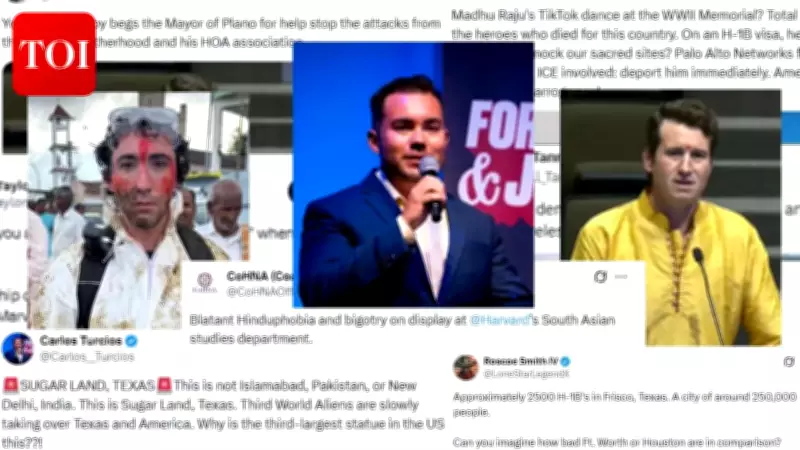
October 2025 witnessed an explosion of anti-H1B visa sentiment online, with vitriol specifically directed at Hindu deities, traditions, and names. A viral February post featured Republican activist Carlos Turcios criticizing the 90-foot "Statue of Union" depicting Lord Hanuman in Texas, warning about "third world aliens" gradually taking over the state and country.
Other social media content has disparaged Hindu deities as "demon gods" and "monkey gods," with some commentators arguing against immigration that facilitates temple construction. American YouTuber Tyler Oliveira's video mocking Karnataka's Gorehabba festival, titled 'Inside India's Poop-Throwing Festival,' garnered 5 million views while failing to provide cultural context or consult local participants.
Similarly, comedian Alex Stein attended a Plano City Council meeting dressed in traditional Indian attire while sarcastically mocking Hindu practices involving cow worship and related rituals, prompting many Indian-American attendees to walk out in protest.
Physical Attacks and Institutional Insensitivity
Hostility has extended beyond digital spaces to physical violence and vandalism. In 2025, gunshots were fired at an ISKCON temple in Utah during worship services. Multiple Hindu temples faced vandalism in Indiana and Southern California, while a temple statue was attacked in North Carolina. California has documented increased hate crimes targeting Hindus, though antisemitism remains the most reported religious hate crime category in the state.
Educational institutions have also faced criticism. In February 2026, Harvard University was accused of "blatant Hinduphobia" by The Coalition of Hindus of North America for artwork featured on its Department of South Asian Studies website promoting a Sanskrit course. The coalition criticized imagery resembling "a horror movie" featuring a dark Hindu figure with tilak holding a "ghostly figurine." While Harvard issued an apology, the incident highlighted institutional insensitivity toward Hindu traditions.
The Madhu Raja Controversy and Double Standards
The most recent prominent example involves Indian-origin techie Madhu Raja, who filmed a "Don't Rush Challenge" video with a woman at the World War II memorial on the National Mall. Following the video's circulation, Raja faced doxing, demands for his firing from Palo Alto Networks, and calls for deportation based on assumptions about his H-1B visa status.
This response contrasts sharply with numerous viral videos showing American cheerleaders performing flips at the Lincoln Memorial, a bride voguing at the Reflecting Pool, and individuals in Spider-Man suits cartwheeling near WWII memorial fountains—all without similar backlash.
Broader Implications and Future Prospects
Research by the Network Contagion Research Institute (NCRI) indicates that in 2025 alone, approximately 24,000 anti-Indian posts on X received over 300 million views, with anti-Indian content tripling during that year. This escalation of Hinduphobia and anti-Indian sentiment has created complex challenges regarding cultural identity and assimilation.
The case of Indian-American golfer Akshay Bhatia, who secured a dramatic playoff victory at the Arnold Palmer Invitational in March 2026, illustrates these tensions. Some commentators noted his apparent cultural assimilation, suggesting that beyond his name, few obvious markers of Indian identity remained visible.
Despite these pressures, the Carnegie survey indicates that most Indian-Americans do not plan to leave the United States and still recommend it for employment opportunities. This reflects the historical resilience of Indian communities, who have navigated complex power dynamics from British colonial rule to Mughal administration while maintaining cultural and religious practices.
The Continuing Dilemma of Assimilation Versus Identity
For generations, immigrant communities in America have balanced assimilation with cultural preservation. Contemporary Indian-Americans face this challenge in a political environment increasingly shaped by debates over immigration, nationalism, and global competition. The American Dream originally promised opportunity without requiring cultural erasure. For many Indian-Americans, the coming years will test whether this fundamental promise can withstand rising discrimination and prejudice while allowing for the maintenance of visible cultural identity in an increasingly complex social landscape.





