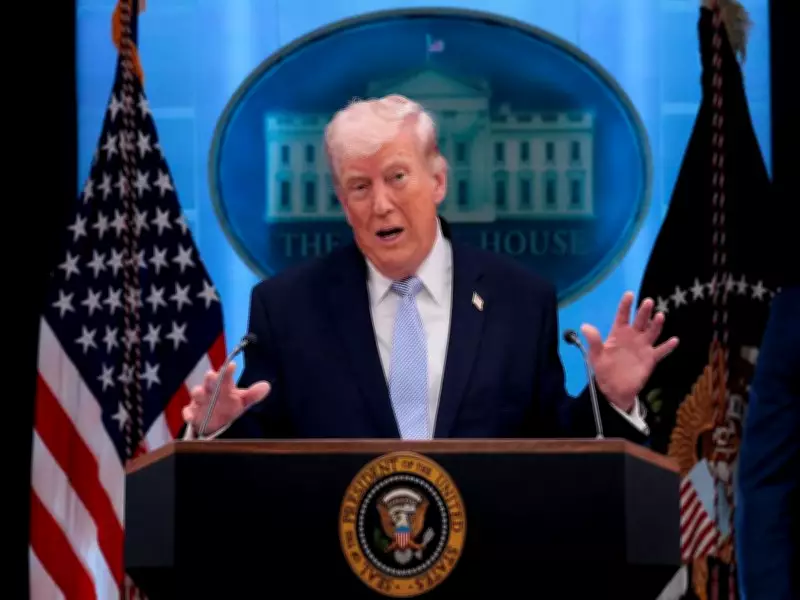
US President Donald Trump stated on Tuesday that the Strait of Hormuz witnessed unprecedented maritime activity on Monday, with 19 million barrels of oil flowing through the strategic waterway, setting an all-time record. Trump attributed this surge to the new diplomatic understanding reached between Washington and Tehran last week.
Trump's Social Media Announcement
In a post on Truth Social, Trump celebrated the outcome of the agreement, writing: "19 Millions barrels of oil flowed out of the Hormuz Strait (on Monday) -- an all-time RECORD." He added, "Oil prices are tumbling down, and the world is a much safer place!" The post highlighted the immediate economic benefits of the diplomatic breakthrough.
White House Press Briefing Details
During a White House press briefing on Tuesday, Trump expanded on his claims, asserting that oil transit through the Strait of Hormuz hit an unprecedented high. He framed the development as a significant milestone, stating, "We took in more oil yesterday than has ever gone through the Strait! We have an oil Gusher. The Strait is totally open." He emphasized that the crucial maritime chokepoint remains completely unobstructed for international maritime trade.

Strategic Goals Achieved
Trump outlined two vital strategic goals secured by his administration: maintaining unhindered global energy flows through the Strait and permanently blocking Iran's path to an atomic bomb. "We have 2 things! We have an open Strait and we have a country that will never have a nuclear weapon," he remarked. He reaffirmed his commitment to regional stability and stated that his administration is actively working to prevent further escalation across the Middle East.
US Lifts Economic Embargo on Iranian Oil
In alignment with this strategic shift, the United States paused its economic embargo on Iranian crude shipments on Monday. This move followed an announcement by US Vice President JD Vance that Tehran would permit the re-entry of United Nations atomic inspectors into the country. Vance told journalists after high-stakes diplomatic deliberations at Switzerland's Burgenstock resort, "We laid a very good foundation for a successful final deal." The talks are aimed at concluding military hostilities involving the US, Israel, and Iran.
Iranian Perspective on the Talks
Iranian Foreign Ministry spokesperson Esmaeil Baqaei provided Tehran's perspective, noting that "a very brief discussion took place regarding the nuclear issue, but there was no discussion of details." The ongoing dialogue builds on momentum from last week, when the two capitals formalized a memorandum of understanding to structure the framework for the Swiss peace talks, following nearly 40 days of intensive military conflict that eventually gave way to a fragile truce. This diplomatic track is specifically designed to address deep-seated contentions that have strained US-Iran relations for generations, with a primary focus on Iran's nuclear enrichment capabilities.
Long-Term Negotiations Ahead
Highlighting the long-term nature of these negotiations, Vance observed, "The final deal is the house. We haven't built the house, but we've laid a successful foundation to get to a good place for the American people." This metaphor underscores that while initial progress has been made, substantial work remains to achieve a comprehensive agreement.
Economic Relief for Iran
Reflecting the immediate economic relief generated by the framework, Iran's Foreign Minister Abbas Araghchi shared an update on social media, stating: "Oil and petrochem exports are waived, blockade lifted, some frozen assets released, and a major reconstruction and development plan launched for Iran." This indicates that Iran is already benefiting from the easing of sanctions.
Regional Complications Persist
Despite these rapid diplomatic strides, regional complications remain. Israeli leadership has voiced strong reservations regarding the transitional understanding. Israeli Prime Minister Benjamin Netanyahu asserted on Monday that Tel Aviv's forces "have full freedom of action to thwart any direct or developing threat" across southern Lebanon. This statement underscores ongoing tensions in the region, even as US-Iran relations appear to improve.