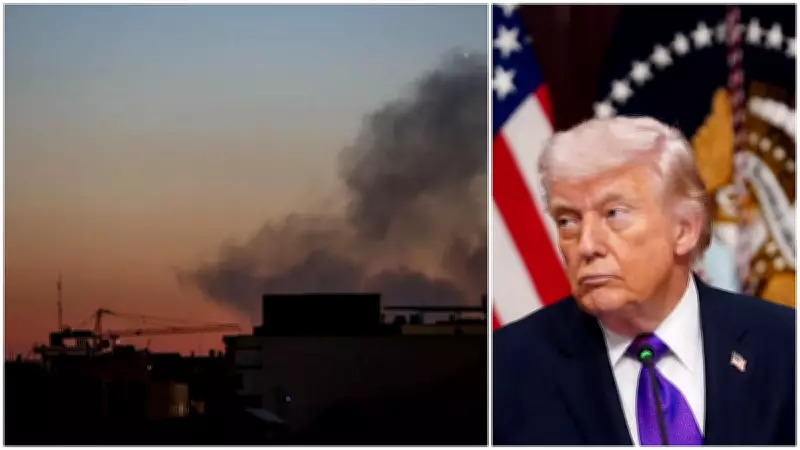
Trump Issues Stark Ultimatum to Iran: Unconditional Surrender or No Deal
In a dramatic escalation of rhetoric, former United States President Donald Trump declared on Friday that there would be "no deal with Iran except unconditional surrender." He asserted that Tehran must capitulate entirely before any diplomatic negotiations could commence, as tensions continue to mount in West Asia following recent military strikes.
Trump's Social Media Post Outlines Demands
Taking to the social media platform Truth Social, Trump outlined his vision for Iran's future. He stated that the United States and its allies, particularly Israel, would only consider an agreement with Iran after the country's leadership had completely yielded and been replaced by what he described as "great & acceptable leader(s)."
"There will be no deal with Iran except UNCONDITIONAL SURRENDER! After that, and the selection of a GREAT & ACCEPTABLE Leader(s), we, and many of our wonderful and very brave allies and partners, will work tirelessly to bring Iran back from the brink of destruction, making it economically bigger, better, and stronger than ever before. IRAN WILL HAVE A GREAT FUTURE. 'MAKE IRAN GREAT AGAIN (MIGA!),'" his post read, echoing his well-known political catchphrase.

Background of Escalating Regional Tensions
Trump's remarks come amid a sharp escalation in regional hostilities. A joint US and Israeli military strike on Iranian territory on February 28 reportedly killed Iran's Supreme Leader Ali Khamenei along with several senior figures, prompting a strong retaliatory response from Tehran.
In retaliation, Iran launched waves of drone and missile attacks across several Arab countries, targeting American military bases and Israeli assets throughout the region. Israel has continued its strikes on Tehran and expanded operations to Lebanon, targeting the militant group Hezbollah.
Trump Seeks Personal Role in Leadership Selection
Earlier on Thursday, in an exclusive interview with Axios, Trump expressed his desire to be personally involved in the selection of Iran's next supreme leader following Khamenei's death. He compared the situation to his involvement in political developments in Venezuela in January after the capture of its former president Nicolas Maduro and his wife in a US military operation.
Trump criticized the possibility of the late Iranian leader's son, Mojtaba Khamenei, succeeding him. Mojtaba, a 56-year-old cleric believed to have close ties with the Islamic Revolutionary Guard Corps, is widely viewed as a frontrunner for the position.
"They are wasting their time. Khamenei's son is a lightweight. I have to be involved in the appointment, like with Delcy [Rodriguez] in Venezuela," Trump said, as quoted by Axios. He described Mojtaba Khamenei as "unacceptable" and stated he would prefer a leader capable of bringing "harmony and peace" to Iran, warning that continuing his father's policies could trigger further conflict with the United States.
Iran's Response and Denials
Reports suggest Iranian authorities have delayed announcing a successor after Khamenei's death, though political signals from Tehran indicate that a decision could be made soon. However, the Iranian government has denied media reports that Mojtaba has been selected as the next supreme leader.
The country's Consulate General in Mumbai rejected the claims in a post on X on Wednesday, stating, "Reports circulating on media regarding potential candidates for leadership selected by Iran's Assembly of Experts have no official source and are officially denied."
Trump's Vision for Iran's Future
According to Axios, Trump also argued that Washington should not accept a new Iranian leader who would pursue policies similar to those of the late Khamenei. He emphasized his commitment to rebuilding Iran after surrender, introducing the slogan "MAKE IRAN GREAT AGAIN (MIGA!)" as part of his plan to revitalize the nation economically and politically.
This stance reflects Trump's broader foreign policy approach, which often combines hardline demands with promises of economic revitalization, mirroring strategies he employed during his presidency in dealings with other nations.