

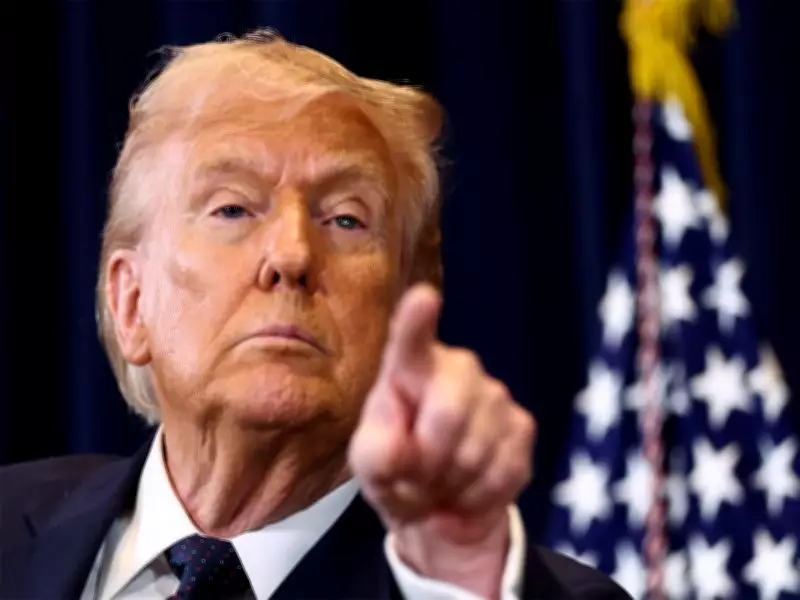
Trump Escalates Rhetoric, Threatens Military Action Against Iran Over Strait of Hormuz
In a stark escalation of tensions in West Asia, former US President Donald Trump has issued a fiery statement vowing aggressive military measures against Iran, including bombing its shoreline and targeting its naval vessels. The remarks, made via a post on Truth Social on Saturday, come amid heightened concerns over the security of the Strait of Hormuz, a critical global oil chokepoint.
Trump Calls for International Coalition to Secure Strategic Waterway
Trump announced that the United States, in conjunction with several other nations, plans to deploy warships to ensure the Strait of Hormuz remains "open and safe." He specifically called upon countries such as China, France, Japan, South Korea, and the United Kingdom to contribute naval assets to the effort. "Many Countries, especially those who are affected by Iran's attempted closure of the Hormuz Strait, will be sending War Ships, in conjunction with the United States of America, to keep the Strait open and safe," Trump wrote.
He further asserted that while Iran's military capability has been largely destroyed, the nation still poses a threat through asymmetric tactics like drone attacks or mine-laying. "We have already destroyed 100% of Iran's Military capability, but it's easy for them to send a drone or two, drop a mine, or deliver a close range missile somewhere along, or in, this Waterway, no matter how badly defeated they are," he added.

Threats of Bombardment and Naval Strikes
In his post, Trump made explicit threats of military action, stating, "In the meantime, the United States will be bombing the hell out of the shoreline, and continually shooting Iranian Boats and Ships out of the water." He emphasized the goal of making the strait "OPEN, SAFE, and FREE!" one way or another, underscoring the urgency of the situation.
Global Implications of the Strait of Hormuz
The Strait of Hormuz is widely regarded as the world's most important oil chokepoint, with over 20 million barrels of crude oil passing through daily. This volume accounts for approximately one-fifth of global oil consumption and nearly a quarter of all seaborne oil trade. Additionally, a significant portion of the world's liquefied natural gas traverses this narrow passage, linking the Gulf with the Arabian Sea.
Any disruption in this region could have severe repercussions on global energy markets, leading to potential shortages and price spikes that affect economies worldwide.
Iran's Response and Concerns Over Global Crisis
In response to the escalating conflict, Abdul Majid Hakeem Ilahi, the representative of Iran's Supreme Leader in India, expressed deep concerns on Saturday. He highlighted that the conflict is not only impacting Iran but has evolved into a global crisis, citing rising energy prices and broader economic disruptions.
"Actually, the crisis is not only for Iran, but it's a global crisis. And they imposed this war on us, and we have to defend ourselves. We are ready to share our blood for our dignity, for our independence, for our country," Ilahi stated. He acknowledged the suffering caused by shortages of gas, petrol, and oil in other nations but maintained that Iran has no choice but to defend itself against what he described as oppression by the US and its allies.
Special Concessions for India Amid Tensions
Ilahi also addressed India's interests in the region, confirming that Indian vessels would be allowed safe passage through the Strait of Hormuz. When asked by ANI if Indian ships could cross the strait, he responded affirmatively, "Of course, of course. Yes." He elaborated that this concession reflects the solidarity shown by the Indian public towards Iran, with many Indians condemning the perceived oppression and opposing the war.
"I can say the majority of Indian people are with Iran. They condemned the oppression. They follow justice. And they don't want war. Even I can say they are against the war," Ilahi added, urging global leaders to pressure the United States to halt hostilities.

As tensions mount, the international community watches closely, with the Strait of Hormuz at the center of a potential flashpoint that could reshape global energy security and geopolitical dynamics.





