

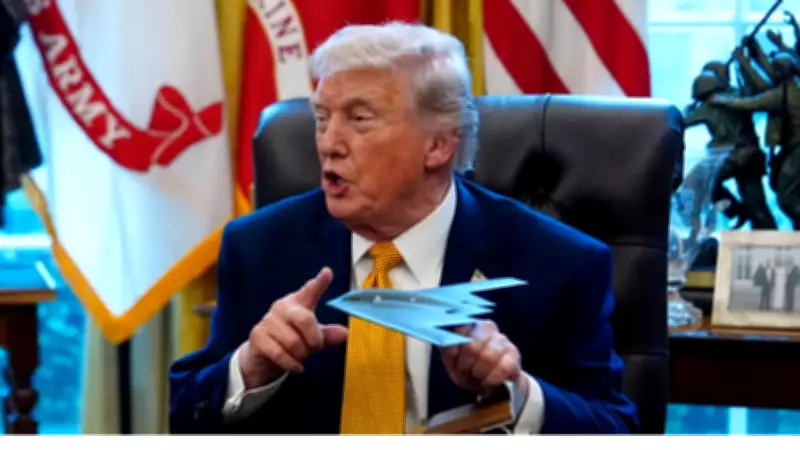
Trump Declares US-Israel Military Campaign Against Iran "Proceeding Very Well"
Former United States President Donald Trump made significant remarks on Tuesday regarding the ongoing joint military operations conducted by the United States and Israel against Iran. Trump asserted that the campaign is "proceeding very well" and emphasized that the extensive damage inflicted on Iranian infrastructure could require at least a decade to rebuild.
Trump's Assessment of the Conflict and Lasting Impact
In statements reported by the ANI news agency, Trump provided a stark evaluation of the military actions. "The war is proceeding very well... We can't let them have a nuclear weapon... They would have used it very gladly... We did a good job," Trump stated. He further highlighted the human cost, claiming, "Every time you see somebody with no legs, no arms, a face that's been really so badly damaged, lives destroyed, 95% chance it came right out of Iran."
Trump elaborated on the strategic objective of ensuring long-term consequences. "They could leave today, and it would take 10 years to rebuild the damage that's been done. But I think we have to make it a little bit more permanent so that no other President has to go through this," he added, suggesting a desire for enduring deterrence against future threats.

Vice President Vance Reinforces Administration's Stance on Regional Threats
Vice President JD Vance echoed the administration's position, addressing the security challenges posed by regional militias. "There have been a lot of militia attacks against our base or our embassy in Iran... There are a lot of terrorists in that region of the world, and we've got to eliminate them when we find them," Vance said, as quoted by the agency. This statement underscores the broader context of counter-terrorism efforts in the region.
US Military Details Precision Strikes on Iranian Missile Facilities
The United States Central Command provided specific details about recent military actions. On Wednesday, the command announced that US forces had deployed "multiple 5,000-pound deep penetrator munitions" against hardened Iranian missile sites located along Iran's coastline near the strategically vital Strait of Hormuz.
In a post on the social media platform X, the command explained the rationale behind the strikes: "Hours ago, U.S. forces successfully employed multiple 5,000-pound deep penetrator munitions on hardened Iranian missile sites along Iran's coastline near the Strait of Hormuz. The Iranian anti-ship cruise missiles in these sites posed a risk to international shipping in the strait." This operation targeted assets deemed a direct threat to maritime security in one of the world's most crucial oil transit routes.
Background of the Ongoing Joint Military Operations
These targeted strikes are part of a series of ongoing operations jointly launched by the United States and Israel on February 28. The campaign is focused on degrading Iran's military capabilities amid significantly heightened tensions across the Middle East. The operations represent a coordinated effort to address perceived threats from Iran's missile programs and its support for regional proxy groups.
Key developments in the conflict include:
- Continuous US-Israel military coordination against Iranian targets.
- Iran's confirmation of the death of its national security chief, Ali Larijani, with President Pezeshkian offering condolences.
- Reports of Iran retaliating with cluster bomb attacks on Tel Aviv.
- Sustained focus on neutralizing missile threats near the Strait of Hormuz to protect international shipping lanes.
The situation remains fluid, with military and political leaders from all involved nations closely monitoring developments. The statements from Trump and Vance, combined with the detailed military reports, highlight the intense and protracted nature of this geopolitical confrontation, with significant implications for regional stability and global security dynamics.






