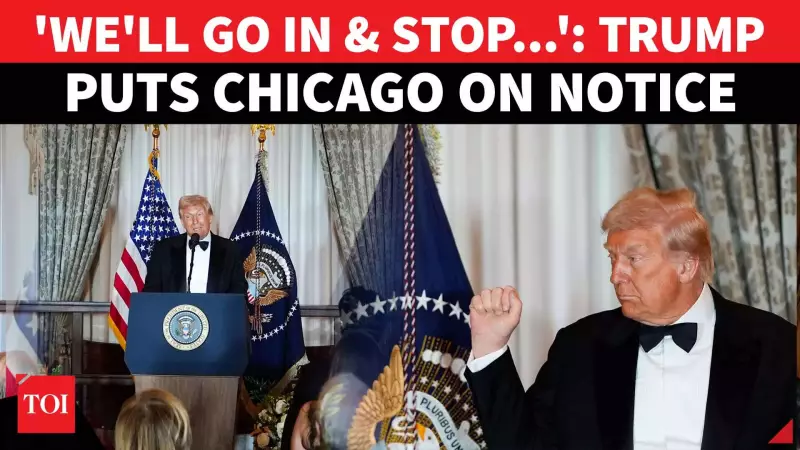
In a dramatic escalation of his tough-on-crime rhetoric, President Donald Trump has directly threatened the city of Chicago with a potential deployment of the National Guard. The warning came during a high-profile event in the nation's capital, signalling a major federal intervention in urban governance.
Trump's Stark Warning at Kennedy Center Honours
Speaking at the Kennedy Center Honours dinner in Washington, D.C., on December 7, 2025, President Trump delivered a fresh and alarming message. Following a State Department-hosted medal presentation for the year's honourees, the President declared his readiness to use military force to address crime within American cities. He explicitly stated that Chicago could be the next target for such an action.
Trump pointed to precedents he has already set, noting the deployment of troops to New Orleans and Memphis. His comments framed the potential move as a necessary response to a failure of local leadership, directly accusing Illinois Governor J.B. Pritzker and Chicago Mayor Brandon Johnson of not doing enough to protect federal officers, specifically mentioning ICE personnel.

Rising Political Tensions and Context
The President's remarks did not occur in a vacuum. They come amid significantly rising political tensions between the White House and Democratic leaders of Illinois. The threat is seen as a direct challenge to the authority of Governor Pritzker and Mayor Johnson, whom Trump has frequently criticised for their approaches to law and order.
The context for this warning is a recent deadly shooting incident near the White House involving the National Guard, which has heightened national discourse on security and the use of military assets domestically. Trump's speech connects this national event to his ongoing critique of crime in specific Democratic-led cities.
Implications and Potential Fallout
The threat to deploy the National Guard to a major city like Chicago carries profound legal, political, and social implications. Such a move would likely face fierce legal challenges from state authorities, potentially creating a constitutional crisis over the limits of federal power versus states' rights.
For the residents of Chicago, the warning introduces a new layer of uncertainty regarding public safety and federal oversight. The statement also solidifies crime and urban policy as central themes for the current administration, setting the stage for continued conflict between federal and local governments. The full address, which details the President's position, has become a focal point for this escalating debate.