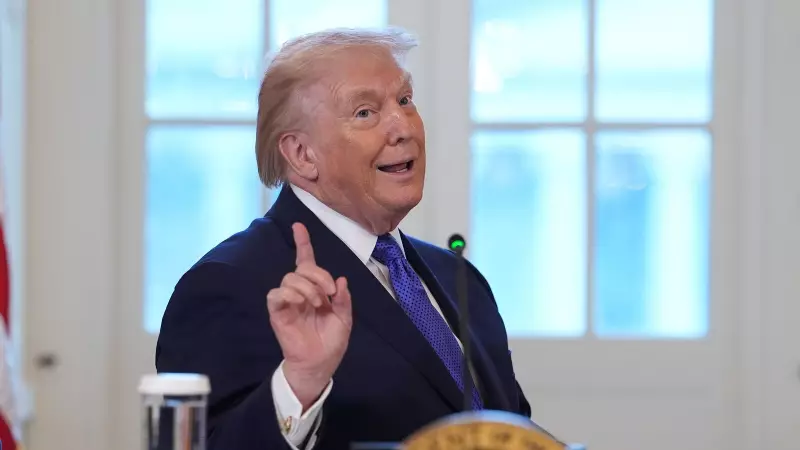
In a move that has ignited a fierce debate across the United States financial and political landscape, President Donald Trump has called for a temporary cap on credit card interest rates at 10%. The announcement, made via a social media post and confirmed by The White House, is slated to take effect from January 20, though specific legislative details remain undisclosed.
Political Promise and Bipartisan History
The proposed cap fulfills a key campaign promise Trump made during the 2024 presidential election run. The chosen date, January 20, marks the anniversary of his second term's inauguration and precedes the crucial US mid-term elections scheduled for November. President Trump stated his administration aims to prevent credit card companies from "ripping off" the American public, framing the measure as a step towards greater affordability.
This is not a novel idea in US politics. Over the years, lawmakers from both major parties have floated similar proposals. Figures like Democratic Senator Bernie Sanders, Republican Senator Josh Hawley, Democratic Representative Alexandria Ocasio-Cortez, and Republican Congresswoman Anna Paulina Luna have all previously advocated for a 10% interest rate ceiling, though none succeeded in turning it into law.

Immediate Reactions: From Skepticism to Warning
The proposal has drawn strong and varied reactions. Democratic Senator Elizabeth Warren, a member of the influential Senate Banking Committee, dismissed the call as "meaningless" without concrete legislative action from Congress. She challenged the President's seriousness, stating she would work to pass a bill if he was genuinely committed.
From the investment world, billionaire investor Bill Ackman warned the President that the cap would be a "mistake." He argued that such a limit would force lenders to cancel cards for millions of consumers, pushing them towards unregulated and costlier loan sharks. Ackman suggested that fostering more competition and innovation among lenders, through regulatory changes, would be a better path to lower rates.
The banking industry's response was unified in its concern. Major financial institutions like American Express, Bank of America, and JPMorgan initially offered no comment. However, a joint statement from leading industry bodies, including the Consumer Bankers Association and the American Bankers Association, cautioned that the cap could backfire. They warned it might drive consumers towards less regulated and more expensive credit alternatives, contrary to the goal of affordable credit.
The Potential Impact: A $100 Billion Question
A pivotal 2025 report from Vanderbilt University titled 'Capping Credit Card Rates' provides a staggering estimate of the proposal's potential impact. The study concludes that American consumers could collectively save approximately $100 billion annually if a federal interest rate cap were implemented.
The report found that bank profit margins are substantial enough across all credit score (FICO) tiers to absorb a significant reduction in interest income. However, it notes a caveat: to maintain profitability, banks might need to cut rewards programs for customers with FICO scores below 760 by up to $27 billion.
Despite this, the net benefit for consumers remains overwhelmingly positive. The study estimates a net saving of $73 billion for consumers overall. In every credit tier, the savings from lower interest would outweigh the value of lost rewards by at least a factor of three. Customers with excellent credit (FICO above 760) would retain their rewards and still share in about $16 billion of the savings.
Contrary to Bill Ackman's suggestion, the Vanderbilt study argues that while increased competition is beneficial, it is unlikely to solve the high-interest rate problem on its own. The researchers suggest that Congressional action to standardize and mandate a reasonable interest rate may be necessary to achieve meaningful change for all Americans burdened by credit card debt.