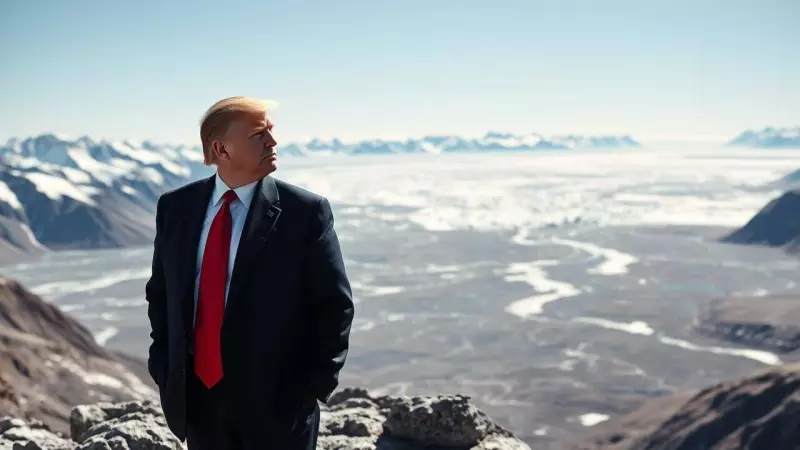
In a recent statement that has sparked widespread discussion, former US President Donald Trump emphasised the strategic need for America to acquire Greenland. His reasoning centred on preventing Russia or China from becoming neighbours of the United States. However, this argument appears to overlook a fundamental geographical and historical reality: Russia is already a neighbour of the US.
The Greenland Assertion and Its Strategic Rationale
Addressing a gathering at the White House, Trump laid out his perspective with characteristic bluntness. "We are going to do something on Greenland, whether they like it or not," he stated. He justified this by saying, "if we don't do it, Russia or China will take over Greenland, and we're not going to have Russia or China as a neighbour." He expressed a preference for a negotiated deal but was clear about his resolve, adding, "I would like to make a deal the easy way, but if not, we are going to do it the hard way."
Trump framed the potential acquisition as a matter of national defence and strategic ownership. He drew a parallel to past international agreements, saying, "When we own it, we defend it... Look at what happened with the horrible deal Obama made with Iran." His core message was that controlling Greenland was essential to prevent rival powers from gaining a foothold close to North America.

The Overlooked Reality: The US-Russia Maritime Border
The claim that acquiring Greenland would prevent a Russian or Chinese neighbourhood misses a critical established fact. The United States and Russia already share a border—a maritime one in the Arctic. This frontier is the narrow Bering Strait, which separates Alaska, a US state, from Russia's Chukotka Peninsula.
At their closest point, the two nations are merely 2.4 miles apart. This proximity is marked by the Diomede Islands: Big Diomede (Russia) and Little Diomede (USA). In winter, the phenomenon of sea ice often creates a temporary ice bridge between these islands, symbolically referred to as an "Ice Curtain" echoing the old "Iron Curtain" of the Cold War era.
Historical Context: Alaska's Purchase from Russia
The existing US-Russia proximity is deeply rooted in history. Alaska was purchased from the Russian Empire by the United States in 1867. The deal, orchestrated by then-US Secretary of State William Seward, was finalised for $7.2 million. This acquisition, initially mocked as "Seward's Folly," proved immensely strategic. It paved the way for Alaska to officially become the 49th state of the USA in 1959.
On the Russian side, the Chukchi Peninsula forms part of the Arctic tundra ecoregion along the East Siberian Sea. This geographical setup underscores how the two global powers have long been face-to-face across the Arctic frontier, a region of growing geopolitical and economic importance due to climate change and resource exploration.
Trump's comments, therefore, highlight a renewed focus on Arctic strategy but within a framework that curiously omits the existing layout of international borders. The discourse shifts attention to the ongoing great power competition in the polar region, where control over territories like Greenland is seen as a key to future influence, despite the pre-existing neighbourhood status of historical rivals.