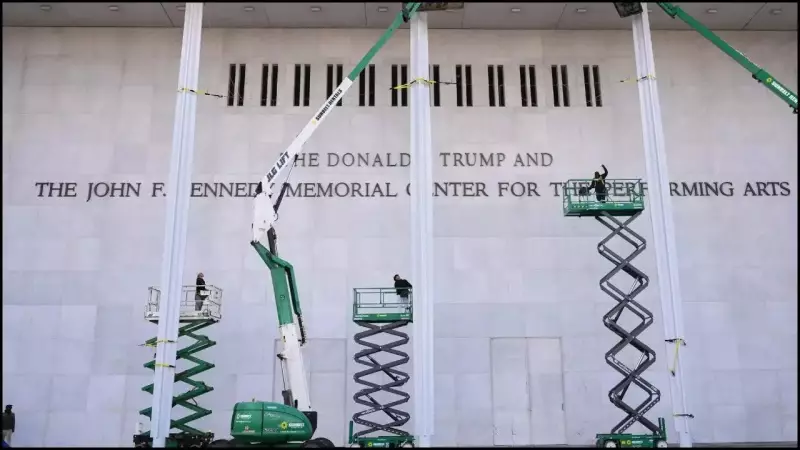
In a significant move that has sparked national conversation, the prestigious Kennedy Center for the Performing Arts in Washington, D.C., has officially added former President Donald J. Trump's name to its title. The institution's board voted unanimously on Friday to change the name to The Donald J. Trump and The John F. Kennedy Memorial Center for the Performing Arts.
A Unanimous Decision and a New Signage
The decision was made by the center's governing board, which agreed to replace the former name, The Kennedy Centre, with the new dual-title. Following the vote, new signage reflecting the updated name was unveiled at the iconic venue's premises. This change places Trump's name alongside that of the 35th President, John F. Kennedy, for whom the center was designated a "living memorial" after his assassination in 1963.
The Historical Legacy of the National Cultural Centre
The story of this performing arts hub began long before its doors opened. President Dwight D. Eisenhower first proposed the idea of a national cultural centre in 1955. His vision was to establish an "artistic mecca" in the nation's capital. He formed a commission to create what was initially called the National Cultural Center.

Three years later, in 1958, the U.S. Congress passed an act to build the venue. Its mandated purpose was clear: to present a wide array of performing arts from America and across the globe. This included:
- Classical and contemporary music
- Opera and drama
- Dance and poetry
The act also required the centre to offer public and educational programmes for all ages, ensuring accessibility.
President Kennedy's administration became deeply involved in fundraising for the project. A major event in November 1962 featured a constellation of stars, including conductor Leonard Bernstein, comedian Danny Kaye, and a young cellist named Yo-Yo Ma. In his speech, Kennedy eloquently argued for the arts as a fundamental pillar of a free society, stating that "the liberation of the human mind and spirit" finds its greatest expression through artistic freedom.
From Kennedy's Vision to Johnson's Great Society
After President Kennedy's death, Congress formally designated the centre as his memorial. It finally opened to the public in 1971. President Lyndon B. Johnson later integrated the centre into his Great Society agenda, framing access to the arts as a basic public need, akin to healthcare.
Philip Kennicott, a Pulitzer Prize-winning critic for The Washington Post, explained this evolution. He noted that while Kennedy created the "intellectual fervour" around the arts, Johnson focused on "popular access and participation at all levels." Kennicott also highlighted the center's enduring balance between being a high-art palace and a publicly accessible space, where anyone can wander in for a free concert.
Controversy and the Path Forward
The name change has not been without its critics. Some Senate Democrats have launched an investigation into the Kennedy Center's leadership, citing allegations of cronyism and corruption. However, drawing a parallel to history, Kennicott predicts the controversy will likely fade. He compared it to the 1998 renaming of Washington National Airport to Ronald Reagan Washington National Airport.
"A lot of people said, 'I will never call it the Reagan National Airport,'" Kennicott recalled. "But pretty much now, decades later, it is Reagan Airport. People don't remember the argument... All it takes is about a half a generation for a name to become part of our unthinking, unconscious vocabulary of place."
The renaming of one of America's most prominent cultural institutions marks a new chapter in its long history, intertwining the legacies of multiple U.S. presidents and ensuring its story remains a part of the nation's ongoing political and artistic dialogue.