

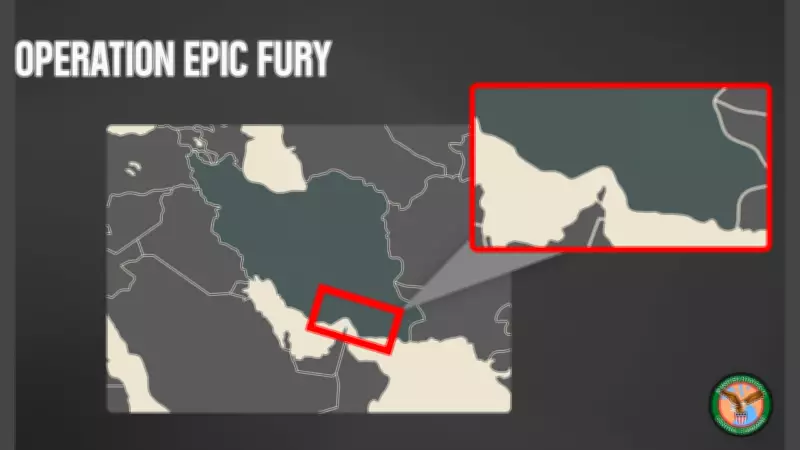
US Military Conducts Precision Strikes on Iranian Missile Sites Near Strait of Hormuz
In a significant escalation of military operations, the United States military announced on Tuesday that it had launched targeted strikes against Iranian missile installations located near the strategic Strait of Hormuz. The operation involved the deployment of some of the most formidable munitions in the US arsenal, specifically designed to penetrate hardened targets.
Details of the Military Operation
United States Central Command issued a formal statement via social media platform X, confirming the successful execution of the strikes. "Hours ago, US forces successfully employed multiple 5,000-pound deep penetrator munitions on hardened Iranian missile sites along Iran’s coastline near the Strait of Hormuz," the statement read. The command further justified the action by emphasizing the perceived threat posed by these installations. "The Iranian anti-ship cruise missiles in these sites posed a risk to international shipping in the strait," it added, underscoring the strategic importance of safeguarding one of the world's most critical maritime chokepoints.
Political Context and Trump's Statements
The military strikes occurred amidst a backdrop of heightened geopolitical tensions. Just hours prior to the announcement, former US President Donald Trump made a series of provocative statements on his Truth Social platform. Trump declared that the United States does not require assistance from its allies in ongoing military engagements against Iran. "We don't need help!" he asserted, adding, "The United States is by far the most powerful country anywhere in the world and they do not need the help of anyone!"

Trump also revealed that several NATO member states had declined to participate in the US-led campaign against Iran. He wrote, "The United States has been informed by most of our Nato 'allies' that they don’t want to get involved with our Military Operation against the Terrorist Regime of Iran, in the Middle East, this, despite the fact that almost every Country strongly agreed with what we are doing, and that Iran cannot, in any way, shape, or form, be allowed to have a Nuclear Weapon." This statement highlights the complex diplomatic dynamics and potential rifts within the Western alliance regarding the conflict.
Escalating Regional Tensions
Meanwhile, the broader Middle East region continues to experience a rapid escalation of hostilities. Recent developments include:
- Confirmation of the death of Iran's security chief in Israeli airstrikes, a significant blow to Iranian leadership.
- Reports from various media outlets indicating that Iran has launched a barrage of missiles targeting Israel, Dubai, and US bases in Baghdad, signaling a retaliatory response.
- Iran's condemnation of Israeli actions, such as the bombing of fuel depots, which it has labeled as 'ecocide,' reflecting the environmental and humanitarian dimensions of the conflict.
These events collectively paint a picture of a region on the brink of a wider conflagration, with multiple state and non-state actors involved in a complex web of military and political maneuvers.
Implications for Global Security
The US strikes near the Strait of Hormuz carry profound implications for international security and global energy markets. The strait is a vital conduit for approximately one-fifth of the world's oil shipments, making any disruption a matter of global concern. The use of heavy munitions by the US demonstrates a clear intent to neutralize perceived threats decisively, while Trump's rhetoric underscores a unilateral approach that may strain traditional alliances.
As the situation evolves, observers are closely monitoring for further military actions, diplomatic interventions, and the potential for miscalculations that could lead to a broader regional war. The involvement of NATO allies, or lack thereof, will likely play a crucial role in shaping the international response and the conflict's trajectory.






