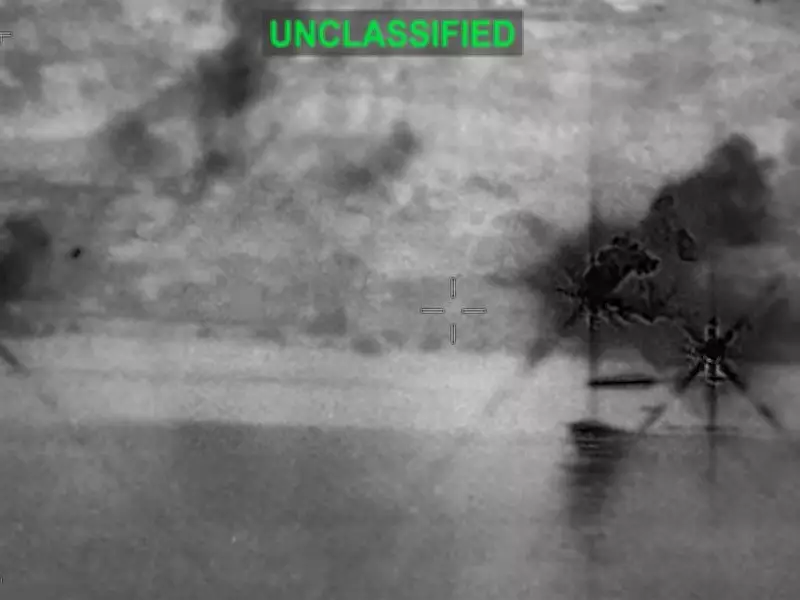
The United States Central Command (CENTCOM) confirmed on Wednesday that its forces have initiated additional strikes against Iran, aiming to further diminish Tehran's capacity to disrupt freedom of navigation in the Strait of Hormuz. This action comes in response to recent attacks on commercial vessels and civilian crews in the strategic waterway.
In a statement posted on X, CENTCOM declared, "At the direction of the Commander in Chief, U.S. Central Command forces have started conducting additional strikes against Iran to further degrade their ability to threaten freedom of navigation in the Strait of Hormuz." The command emphasized that the United States is holding Iran accountable for what it termed "unjustified aggression against commercial shipping and civilian crews freely navigating a vital international waterway."
Power Cuts and Explosions Reported in Iranian Cities
Following the announcement of fresh airstrikes, Iran's southern port city of Chabahar experienced power cuts, according to CNN, citing Iranian state media. The state-run Islamic Republic News Agency (IRNA) reported approximately 10 explosions in Chabahar and the nearby coastal city of Konarak. IRNA added, "Electricity has also been cut in parts of the city of Chabahar," noting that the incident is under investigation.

Additional explosions were reported in the Iranian city of Bushehr, home to the Bushehr Nuclear Power Plant, as cited by CNN from the semi-official Fars news agency. The exact location of those blasts remains unclear. Furthermore, explosions were heard on Iran's Abu Musa Island, with three more blasts near Tahrouyi village in the southern city of Sirik, as reported by Al Jazeera citing Press TV.
Context of the Latest Strikes
These strikes follow a major US military operation on July 7, when CENTCOM forces conducted a new round of offensive strikes against Iran, hitting more than 80 targets with precision munitions. That operation was a response to alleged Iranian attacks on commercial vessels transiting the Strait of Hormuz. CENTCOM stated that the strikes targeted Iranian air defense systems, command-and-control networks, coastal radar sites, anti-ship missile capabilities, and over 60 small boats operated by the Islamic Revolutionary Guard Corps (IRGC) in and around the Strait of Hormuz.
The US military asserted that the operation aimed to reduce Iran's ability to carry out further attacks on international shipping. Washington alleged that Iran recently targeted three commercial vessels passing through the waterway: the Marshall Islands-flagged M/T Al Rekayyat, Saudi Arabia-flagged M/T Wedyan, and Liberia-flagged M/T Cyprus Prosperity.
US Accuses Iran of Ceasefire Violation
Calling the alleged attacks a violation of the ceasefire agreement, CENTCOM stated, "The unwarranted aggression by Iranian forces is a clear and dangerous violation of the ceasefire and undermines freedom of navigation." The command added, "CENTCOM forces remain postured and prepared to hold Iran accountable when the agreement is not adhered to or obeyed."
The Strait of Hormuz is a critical chokepoint for global oil shipments, and any disruption there can have significant economic and geopolitical repercussions. The ongoing US-Iran tensions continue to pose risks to maritime security in the region.