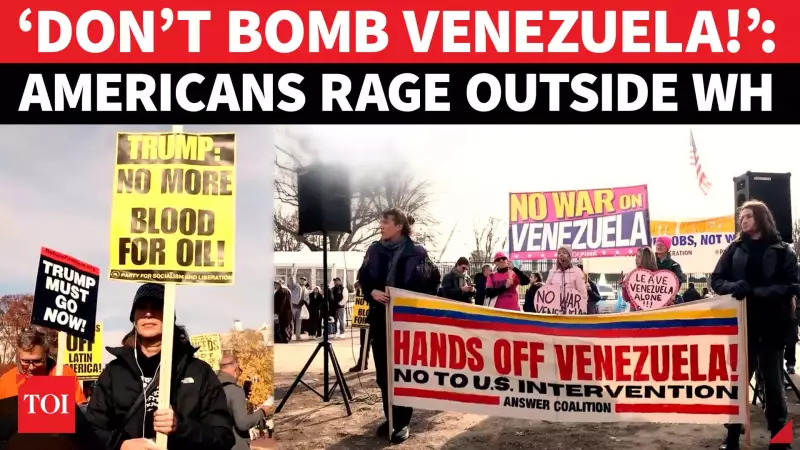
Washington DC witnessed heated protests outside the White House as former President Donald Trump's renewed threats of military action against Venezuela collided with revelations of China's dominant role in buying the South American nation's oil. The demonstrators, carrying signs with slogans like 'No Blood For Oil', voiced strong opposition to any potential US intervention, highlighting the complex geopolitical web involving sanctions, energy, and great-power rivalry.
China's Strategic Oil Play and Sanction Evasion
At the heart of the escalating tension is China's emergence as the top buyer of Venezuelan crude, importing nearly 268,000 barrels per day. A significant portion of this oil is allegedly being re-labelled to circumvent strict US sanctions imposed on Nicolas Maduro's regime. This massive energy transfer is viewed not just as a commercial transaction but as a strategic move that solidifies Beijing's influence in Caracas and secures a vital resource stream. Analysts interpret Washington's aggressive posture, including Trump's threats, as a direct challenge aimed at disrupting China's carefully built resource networks in Latin America.
Military Posturing and Domestic Backlash
The situation on the ground remains volatile. In a show of force, the Venezuelan government under Maduro recently swore in 5,600 new soldiers, with officials declaring the nation is 'READY FOR WAR'. This mobilization is a direct response to the bellicose rhetoric emanating from Washington. Meanwhile, in the US capital, the political discourse is equally charged. The protests in DC, with dozens rallying against potential 'boat strikes' or an invasion, reflect a deep domestic divide over foreign military adventures. The confrontation has sparked fears that a localized conflict could spiral into a wider geopolitical showdown, drawing in major powers and destabilising the region further.

A Looming Global Confrontation?
The Venezuela crisis is rapidly becoming a flashpoint in the broader US-China competition. Trump's warnings are seen by many observers as a test of Washington's willingness to enforce its sanctions regime even when it conflicts with Beijing's core energy interests. The standoff raises critical questions about the future of unilateral sanctions as a tool of US foreign policy in a multipolar world where other nations like China can provide economic lifelines. The events underscore a shift where regional conflicts are increasingly viewed through the prism of great-power rivalry, with nations like Venezuela becoming pawns in a larger strategic game. The outcome here could set a precedent for how such resource-and-influence clashes are managed globally.