

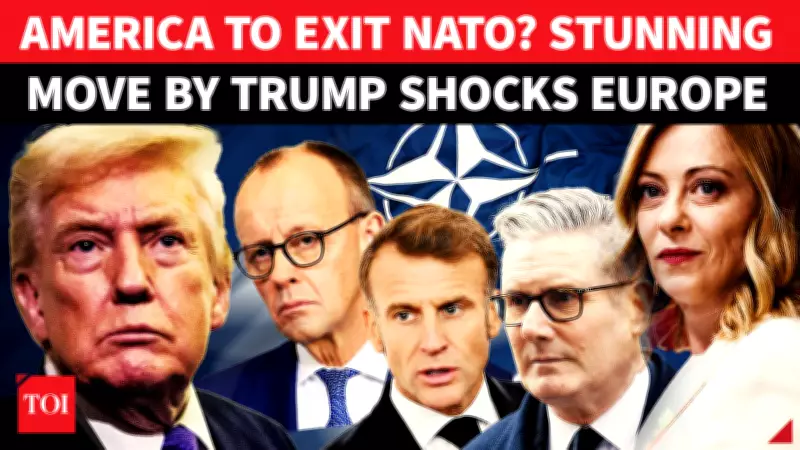
US Withdraws Generals From Key NATO Bases in Europe, Signaling Major Alliance Shift
In a move that underscores deepening fissures within the transatlantic alliance, the United States is preparing to withdraw its generals from two of NATO's most pivotal command posts. According to a Reuters report, Washington will relinquish leadership of NATO commands in Naples, Italy, and Norfolk, Virginia, to European officers. This decision represents a profound shift in an alliance historically dominated by U.S. military authority and strategic oversight.
A Routine Rotation or Strategic Recalibration?
While NATO officials have characterized the withdrawal as a standard "rotation" of leadership positions, critics and analysts interpret it as a deliberate component of President Donald Trump's broader agenda to foster a Europe-led NATO framework. Trump has consistently advocated for European nations to assume greater responsibility for their own defense, repeatedly emphasizing that the era of American primacy as Europe's primary security guarantor is drawing to a close.
This strategic recalibration raises critical questions about the future dynamics of the alliance. Is the United States incrementally loosening its grip on NATO's operational command structures? Moreover, is Europe adequately prepared to shoulder the enhanced security burdens that such a transition entails?

Implications for Transatlantic Security
The withdrawal of U.S. generals from these key bases is not merely a procedural adjustment; it symbolizes a potential redefinition of NATO's foundational principles. For decades, American leadership has been the cornerstone of the alliance's military efficacy and deterrence capabilities. This shift could herald a new chapter where European member states must enhance their defense investments, coordination, and strategic autonomy.
The move fuels ongoing speculation regarding the United States' long-term commitment to NATO amidst evolving global security landscapes. It also highlights the pressing need for European allies to bolster their military readiness and interoperability to ensure the alliance's continued relevance and effectiveness.
Broader Context and Future Prospects
This development occurs against a backdrop of President Trump's persistent calls for NATO members to meet their defense spending commitments. His administration's policies have increasingly emphasized burden-sharing, arguing that European security should be primarily managed by European nations. The handover of command in Naples and Norfolk may thus be viewed as a tangible manifestation of this philosophy.
As the United States steps back from these leadership roles, the onus will fall on European officers to navigate complex security challenges, from regional tensions to cyber threats. The success of this transition will likely depend on several factors:
- The ability of European militaries to integrate and operate seamlessly under new command structures.
- The political will among European governments to sustain increased defense expenditures.
- The ongoing strategic dialogue between the U.S. and its NATO allies to maintain cohesion and shared objectives.
Ultimately, this major power shift within NATO could redefine transatlantic relations for years to come, prompting a reevaluation of roles, responsibilities, and collective security strategies in an increasingly multipolar world.






