

Andhra Pradesh Government Unveils Comprehensive Governance Plan for Amaravati
The Andhra Pradesh state government is actively developing a unique and comprehensive governance framework specifically designed for Amaravati, the state's capital city. This ambitious initiative aims to establish a robust legal status and administrative autonomy for the capital, while simultaneously implementing substantial fiscal powers and revenue arrangements to ensure sustainable development.
Legal and Administrative Reforms
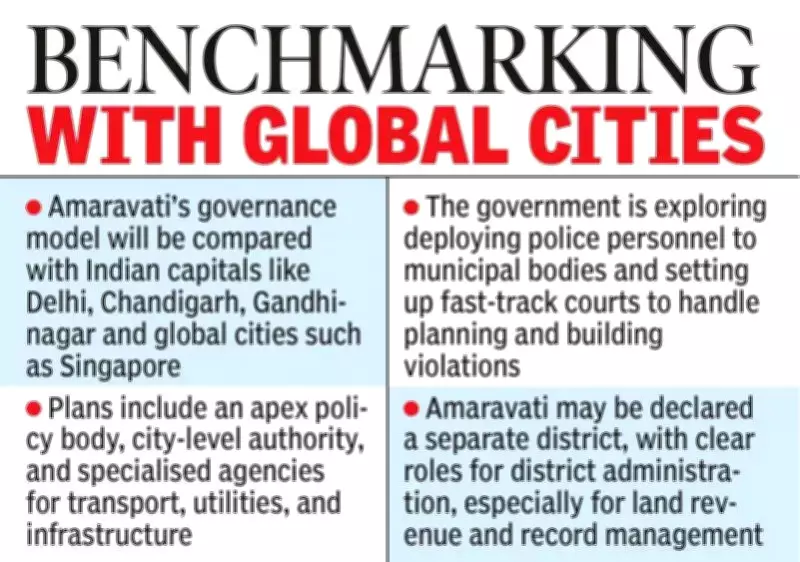
As a central component of this framework, the government is seriously considering the introduction of a Capital City Governance Act, should such legislation prove necessary. This would provide a solid legal foundation for Amaravati's administration. Furthermore, authorities are exploring the feasibility of allocating dedicated police personnel to municipal bodies and establishing fast-track courts specifically to handle planning violations and urban development disputes efficiently.
According to the draft framework, the government proposes to conduct a thorough review and potential amendment of existing municipal laws, including the APCRDA Act (Andhra Pradesh Capital Region Development Authority Act), to facilitate and empower Amaravati's city governance structure. This legal overhaul is seen as essential for creating a responsive and effective administrative system.

National and International Benchmarking
The state plans to benchmark Amaravati's governance model against both national and international capital cities to adopt best practices. Detailed case studies from prominent Indian capitals will be examined, including:
- Delhi
- Chandigarh
- Navi Mumbai
- Gandhinagar
- New Town in Kolkata
Additionally, the government will analyze global examples such as:
- Brasília (Brazil)
- Putrajaya (Malaysia)
- Sejong (South Korea)
- Astana (Kazakhstan)
- Nusantara (Indonesia)
- Singapore
- Johannesburg (South Africa)
Dedicated Governance Architecture
Beyond legal reforms, the government is planning to design a dedicated governance architecture tailored specifically for Amaravati. This includes examining the applicability of a metropolitan planning committee for the Amaravati capital region, ensuring alignment with constitutional provisions. Various structural options are being explored, such as the introduction of an apex policy body, a city-level authority, and specialized agencies focused on transport, utilities, and critical infrastructure management.
Another significant proposal under consideration is making Amaravati a separate district, with clearly defined roles for the district administration. This would particularly involve responsibilities related to land revenue and comprehensive record management, streamlining bureaucratic processes.
Fiscal Sustainability and Revenue Models
Fiscal sustainability forms a central pillar of the entire governance proposal. The state government is evaluating a diverse mix of revenue-generation mechanisms, including:
- Property tax reforms
- User charges for municipal services
- Land value capture instruments
- Inter-governmental transfers
- Shared revenue arrangements between the state and the proposed Amaravati city government
The plan also includes establishing clear asset and liability sharing mechanisms between the APCRDA and the proposed municipal entity. This would address outstanding loans and repayment obligations, ensuring financial transparency and responsibility.
Institutional Capacity and Inclusive Governance
The framework proposes comprehensive institutional staffing and capacity-building plans, drawing insights from best practices observed in new towns across India and internationally. Importantly, the governance systems are designed to integrate gender equity principles, climate resilience strategies, and robust disaster preparedness measures from the outset.

The implementation process will involve at least three structured stakeholder workshops with APCRDA and other relevant agencies. These consultations will follow the preparation of a detailed Amaravati institutional design report, which will outline specific powers, revenue models, organizational structures, and performance monitoring systems for each proposed institution.





