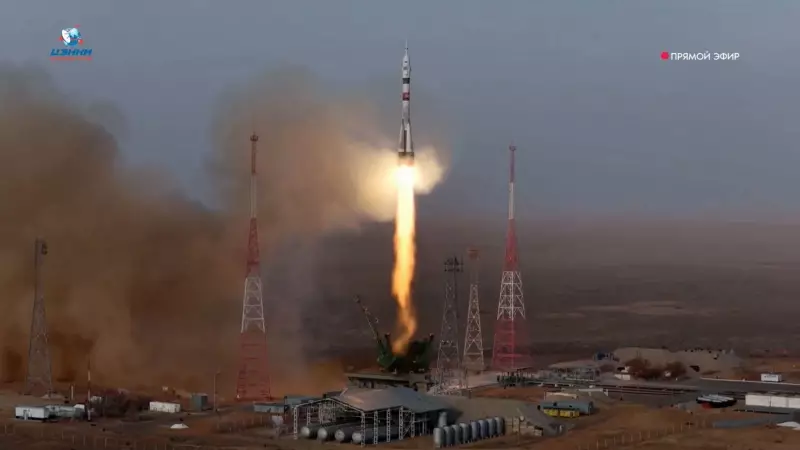
In a powerful demonstration of ongoing international space cooperation, a Russian Soyuz rocket successfully blasted off from Kazakhstan on Saturday, carrying a NASA astronaut and two Russian cosmonauts to the International Space Station. The launch marks another chapter in the enduring partnership between the United States and Russia in space exploration, despite geopolitical tensions on Earth.
Historic Launch Amid Global Tensions
The Soyuz MS-25 spacecraft lifted off precisely at 8:36 p.m. local time from the Baikonur Cosmodrome in Kazakhstan, piercing through the night sky with its characteristic orange glow. Onboard were NASA astronaut Tracy Dyson, Russian cosmonaut Oleg Novitsky, and Belarusian cosmonaut Marina Vasilevskaya. The successful launch represents a significant milestone in space diplomacy and scientific collaboration.
This mission is particularly noteworthy as it continues the long-standing tradition of US-Russian cooperation in space that has persisted through various political challenges. The International Space Station remains one of the few areas where collaboration between the two nations continues uninterrupted, serving as a symbol of what humanity can achieve when working together toward common scientific goals.

Meet the International Crew
Tracy Dyson, the American astronaut on this mission, brings extensive experience to the expedition. She has previously completed two spaceflights and multiple spacewalks, making her an invaluable asset to the ISS crew. Dyson is scheduled to spend approximately six months aboard the orbiting laboratory, where she will conduct numerous scientific experiments and maintenance activities.
Russian cosmonaut Oleg Novitsky commands the Soyuz spacecraft, drawing on his previous spaceflight experience. Belarus's Marina Vasilevskaya makes history as she becomes one of the first Belarusian cosmonauts to visit the space station, though her stay will be relatively short before returning with Novitsky.
The crew is expected to dock with the International Space Station after a two-day orbital journey, joining the seven crew members already aboard the orbiting laboratory. This will bring the total crew complement to ten people, allowing for an intensive period of scientific research and station maintenance.
Ongoing International Space Cooperation
The Soyuz launch occurs at a time when space cooperation between nations has become increasingly important. NASA and Roscosmos, the Russian space agency, have maintained their partnership ensuring continuous human presence aboard the ISS. This collaboration includes crew exchanges and shared responsibilities for station operations.
The International Space Station has been continuously occupied for more than twenty years, serving as a unique microgravity laboratory where crew members conduct experiments in biology, human biology, physics, astronomy, and other fields. The research conducted aboard the station has led to numerous scientific breakthroughs and technological advancements that benefit life on Earth.
This launch also highlights the importance of having multiple transportation options to and from the space station. While NASA now works with commercial partners like SpaceX for crew transportation, the continued availability of Soyuz spacecraft ensures redundancy and reliability for crew rotations.
The successful launch reinforces the commitment of multiple nations to maintain the International Space Station as a beacon of international cooperation and scientific discovery. As the crew begins their mission, they carry with them the hopes of scientists and citizens around the world who believe in the power of space exploration to unite humanity and expand our understanding of the universe.