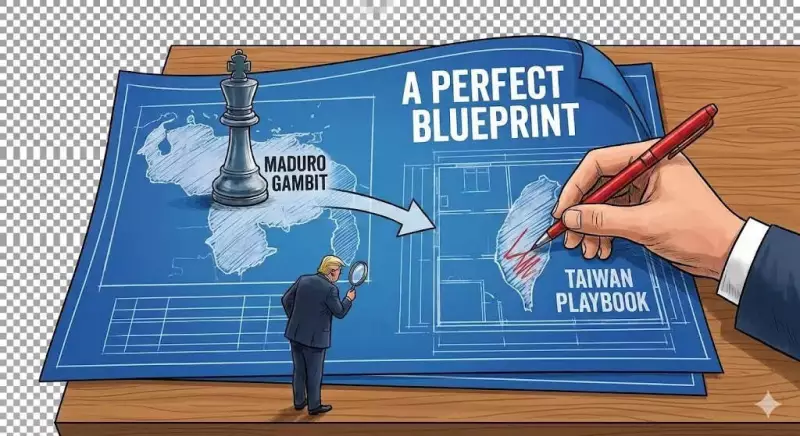
The global order received a seismic shock when US special forces captured Venezuelan President Nicolas Maduro in a surprise operation. President Donald Trump's subsequent declaration that America would now "run" the South American nation did more than just topple a regime. It fractured a fundamental assumption of the post-Cold War era: that even superpowers must at least pretend to follow international rules.
A New Precedent for Power Politics
President Trump's audacious move, executed without congressional approval or a United Nations mandate, is sending shockwaves far beyond Latin America. In Asia, it is fueling a sharper and more urgent question: Could China's leader Xi Jinping attempt a similar play against Taiwan? What was once an abstract legal debate has transformed into a live geopolitical concern. From Washington to Beijing to Taipei, officials and analysts are urgently reassessing how much international law still constrains great powers—and who benefits if those constraints vanish.
Trump made little effort to cloak the Venezuela operation in diplomatic language. He framed it as a combination of law enforcement, counter-narcotics, regime change, and economic recovery. "We're going to run the country until such time as we can do a safe, proper, and judicious transition," he stated. When questioned about funding the occupation, he pointed to Venezuela's natural resources: "Money coming out of the ground. We're going to be taking a tremendous amount of wealth out of the ground," referring to the nation's vast oil reserves.

Global Repercussions and the Taiwan Question
This action directly challenges the long-standing US position as the chief defender of a rules-based international order, particularly concerning sovereignty. Critics argue the damage is global. If Washington asserts the right to invade a country, seize its president, and oversee its governance indefinitely, rivals could claim the same latitude in their own spheres of influence.
Democratic Senator Mark Warner voiced this fear bluntly, warning, "if the United States asserts the right to use military force to invade and capture foreign leaders it accuses of criminal conduct, what prevents China from claiming the same authority over Taiwan's leadership?" He added that once this threshold is crossed, "the rules that restrain global chaos begin to collapse."
Trump's team insists the raid was lawful because Maduro had been indicted in a US court—a justification many international law experts flatly reject. Critics argue this rationale creates a dangerous doctrine where any powerful state can criminalize a foreign leader to justify military action.
Beijing's Calculated Response and Strategic Calculus
Publicly, Beijing condemned the US operation in harsh terms. China's foreign ministry called it "hegemonic behavior" that "seriously violates international law" and demanded Maduro's immediate release. Yet, the official outrage is only part of the story. On Chinese social media platform Weibo, the raid racked up hundreds of millions of views. Some users openly praised it as a blueprint for handling Taiwan, with comments like, "I suggest using the same method to reclaim Taiwan in the future."
Analysts like Ryan Hass, a former US diplomat now at the Brookings Institution, caution that Venezuela alone won't transform Beijing's strategy overnight. However, he noted China may now privately emphasize that it expects "the same latitude for great power exemptions to international law that the US takes for itself."
While a Venezuela-style lightning raid on Taiwan would be vastly more complex due to the island's modern military and global economic significance in semiconductor manufacturing, precedents matter. Lyle Morris of the Asia Society Policy Institute said Trump's actions fit neatly into how Beijing already views great-power behavior. "To Xi, Trump's actions could be viewed as consistent with great powers intervening in neighboring countries in the name of national security," Morris stated.
Trump's move also feeds a narrative Beijing eagerly promotes: that the US is abandoning the international order it built. Chinese state media seized on Trump's comments about extracting Venezuelan oil to pay US costs as proof of a return to a "colonial era of barbaric plunder."

The Bottom Line: A World of Weakened Rules
Most experts agree Xi is unlikely to immediately attempt a copycat strike on Taiwan due to enormous military, economic, and political risks. However, Trump's actions have already shifted the strategic debate. They have lowered the rhetorical and legal barriers that once made sovereignty violations seem universally unacceptable.
The operation complicates US messaging, especially as Trump has previously downplayed Taiwan invasion risks and suggested Taipei should pay more for American protection. As Jennifer Kavanagh of Defense Priorities noted, Venezuela raises the troubling question: "if the US can declare a leader illegitimate, go and remove him and then run the country, why can't other countries?"
Strategically, the Venezuela operation has irrevocably changed the conversation in Beijing, Washington, and Taipei. Xi Jinping does not need to follow Trump's playbook step-by-step for the precedent to be impactful. The signal is now clear: raw power can override established rules if the justification is framed broadly enough. The world is now left grappling with a question that barely existed before: If Trump can do a Venezuela, what's to stop Xi Jinping from doing a Taiwan?