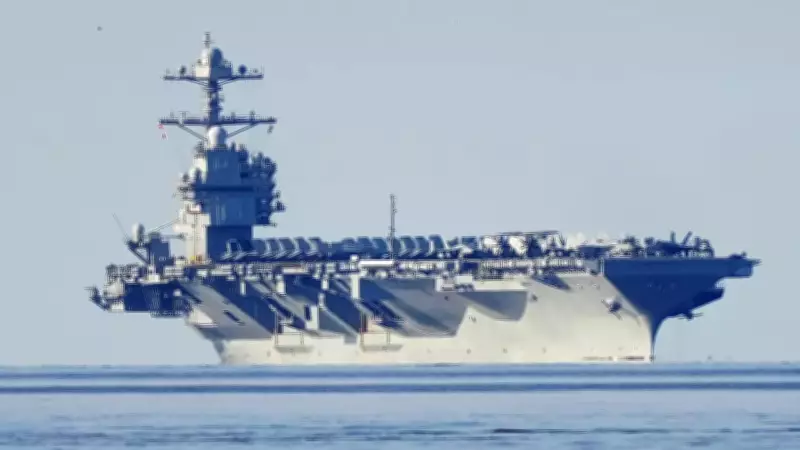
US Sends Advanced USS Gerald R. Ford Carrier to Middle East in Major Escalation with Iran
The United States has directed one of its most sophisticated naval assets, the USS Gerald R. Ford, to the Middle East. This move is widely perceived as a significant escalation in military signaling toward Iran, as tensions over Tehran's nuclear program intensify. The deployment occurs amid increased pressure from President Donald Trump on Iran to secure an agreement on its nuclear activities, with warnings of "very traumatic" consequences if negotiations fail in the coming weeks.
Dual Carrier Presence in the Region
The USS Gerald R. Ford (CVN-78), currently transiting from the Caribbean, is expected to join the USS Abraham Lincoln carrier strike group already operating in the Middle East. The presence of two US aircraft carriers in or near the region is relatively rare and is typically interpreted as a show of force aimed at deterrence during periods of heightened geopolitical tension. This dual deployment underscores the strategic importance Washington places on the evolving situation with Iran.
What is the USS Gerald R. Ford?
Commissioned as the lead ship of a new class of US Navy carriers, the Gerald R. Ford represents the most technologically advanced aircraft carrier ever deployed by the United States. It is the first new carrier design introduced in over four decades, incorporating several major upgrades over the older Nimitz-class vessels it is intended to replace.

- Electromagnetic Aircraft Launch System (EMALS): This system replaces traditional steam catapults, enabling faster and more efficient aircraft launches. EMALS allows the carrier to generate a higher sortie rate, improving operational tempo during sustained combat operations.
- Size and Power: Measuring approximately 1,106 feet in length—roughly the size of three football fields—the nuclear-powered carrier displaces around 100,000 long tons when fully loaded. Powered by two A1B nuclear reactors, it has a virtually unlimited operational range and can sustain speeds exceeding 30 knots.
- Aircraft Capacity: Its air wing can accommodate more than 75 aircraft, including F-35C Lightning II stealth fighters and F/A-18E/F Super Hornets, making it a central component of US naval power projection.
Rapid Redeployment and Operational Shift
The current mission marks a swift change in operational plans for the carrier. The Gerald R. Ford has been deployed at sea since June 2025, initially operating in European waters before being redirected to the Caribbean later in the year. US officials noted that the carrier played a role in operations connected to the capture of Venezuelan leader Nicolás Maduro.
Instead of returning to its homeport in Norfolk, Virginia, for scheduled maintenance, the carrier has now been ordered to proceed toward West Asia. This decision highlights the urgency Washington attaches to the situation with Iran. Speaking to reporters, President Trump indicated that the deployment was intended to ensure military readiness should diplomatic efforts falter. "In case we don't make a deal, we'll need it... If we need it, we'll have it ready," he said, while expressing hope that negotiations would ultimately succeed.
Regional Reactions and US-Iran Tensions
The anticipated arrival of the carrier strike group in the Persian Gulf or Arabian Sea has drawn mixed reactions across the region. US officials describe the buildup as a stabilizing deterrent meant to discourage escalation. However, Gulf states have privately expressed concern that an increased American military presence could heighten tensions and risk miscalculation, potentially exacerbating the already fragile geopolitical landscape.
This deployment comes at a critical juncture in US-Iran relations, with ongoing nuclear talks at a delicate stage. The move signals Washington's willingness to leverage military assets to reinforce diplomatic efforts, aiming to pressure Tehran into compliance while preparing for contingencies should negotiations break down.