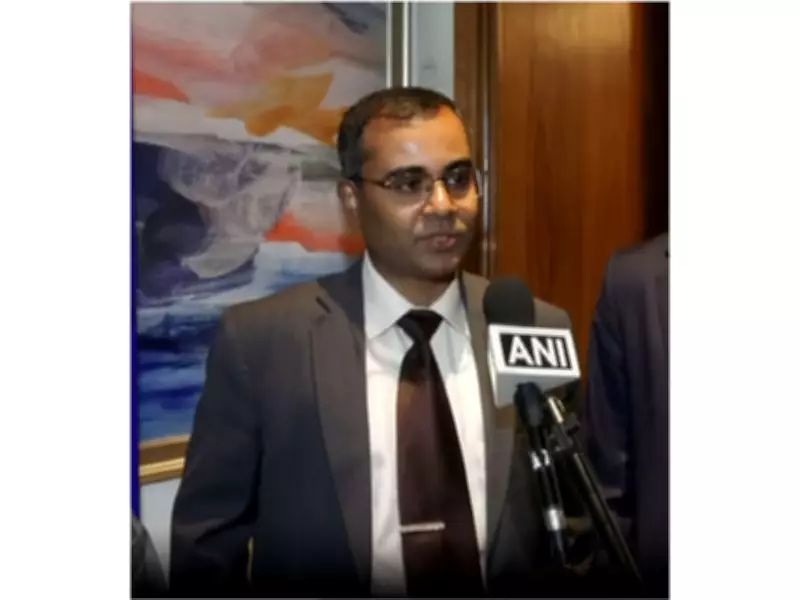
The government is actively exploring reforms such as digital notarisation to streamline document verification and facilitate the onboarding of foreign nationals and non-resident Indians (NRIs) into India's financial system, according to Harsha Bhowmik, Director of the Department of Economic Affairs (DEA) under the Ministry of Finance.
Current Challenges in Digital KYC for NRIs
Speaking at an interactive session on Credible Growth: Capital, Entrepreneurship & Financial Reporting organised by the Confederation of Indian Industry (CII) on Friday, Bhowmik highlighted that while Aadhaar has become the most fundamental Know Your Customer (KYC) document in India, Aadhaar-based authentication currently faces IP restrictions for users accessing it from outside the country. This makes it difficult even for NRIs who possess Aadhaar cards to complete digital KYC. "The most fundamental KYC document which we right now use is Aadhaar, which is completely digital. But for bringing Aadhaar-based authentication from outside India, there are IP restrictions. So, if an NRI has an Aadhaar, still he can't do KYC. We are trying to see how those blocks can be withdrawn," he said.
Digital Notarisation as a Potential Solution
Bhowmik noted that the current system offers only traditional notarisation, with no option for digital notarisation. "Whether digital notarisation can be an option, then again amendments have to be done to the Acts and the Rules. There are multiple aspects to this. It is about getting the complexity of onboarding foreign nationals and NRIs into our financial system, and for enterprises also. We are trying to solve for that," he explained.

He also mentioned that Aadhaar is developing a verified signature-based solution that may not have IP restrictions, potentially easing KYC for NRIs. Additionally, a key challenge is the lack of interoperability between Indian and foreign digital signatures. Digital signatures in India are governed under the Information Technology (IT) Act, and currently only signatures issued by Indian certifying authorities are recognised, requiring foreign nationals to obtain Indian digital signatures before submitting documents digitally.
Expanding TReDS for MSME Financing
Turning to access to finance for micro, small and medium enterprises (MSMEs), Bhowmik said the government is expanding the use of the Trade Receivables Discounting System (TReDS). This includes onboarding all Central Public Sector Enterprises (CPSEs) onto the platform. "We're trying to onboard all the CPSEs, like the Central Public Sector Enterprises, onto TReDS. Based on that, the CPSEs' invoices have to be financed through TReDS itself. Because we are so diligent in terms of getting the money to the MSMEs within 45 days, that somehow can be tracked," he stated.
Three entities currently operate the TReDS platform, and there are multiple invoice financing models, including supplier-based financing and buyer-accepted financing, with the latter being "the more robust and the most confirmed one" where banks extend credit after buyers accept suppliers' invoices.
Integration with Account Aggregator and GST Returns
Bhowmik said the government is also integrating the Account Aggregator framework with Goods and Services Tax (GST) returns and subsequently with TReDS to facilitate cash flow-based lending. The proposed integration of TReDS with the Government e-Marketplace (GeM) would further enable MSMEs to participate in government tenders, raise invoices, and access financing through a seamless digital ecosystem.
Credit Guarantee Scheme and Digital Public Infrastructure
He added that the Credit Guarantee Scheme has been expanded from Rs 5 crore to Rs 10 crore, while the government is also exploring financialisation of leveraged invoices to improve credit flow. Bhowmik said India's Digital Public Infrastructure (DPI), comprising digital identity, payments, and the Account Aggregator framework, has evolved with a welfare-oriented approach, enabling affordable access to financial services while reducing costs for startups and encouraging innovation.
Inviting suggestions from industry, Bhowmik said the government has "only scratched the surface" of the opportunities presented by India's digital public infrastructure and encouraged stakeholders to identify new use cases for these initiatives.

Speaking to ANI on the sidelines of the event, Bhowmik described it as a wonderful interactive session with industry partners on Credible Growth, providing more insights on how to make India's vision of Viksit Bharat by 2047 a reality.