

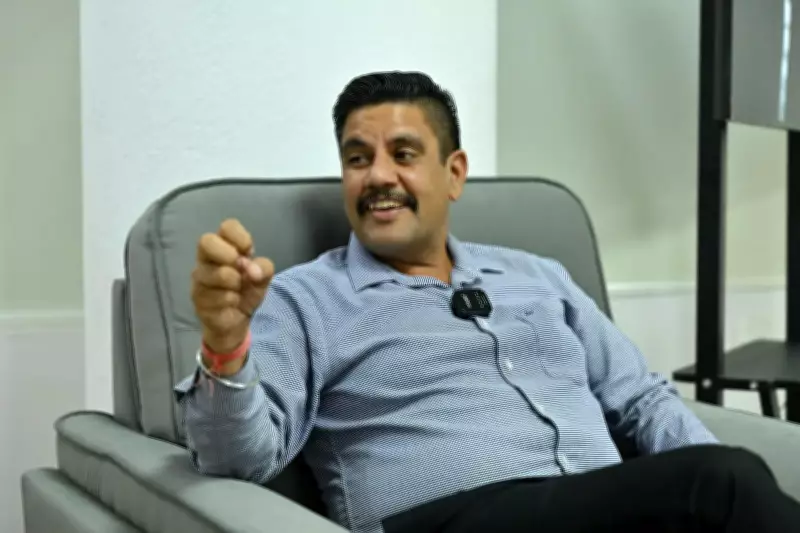
Working as a bureaucrat in a state government is never easy for an army officer who has spent a lifetime in uniform, traversing the peaks and valleys of the Himalayas. But Colonel Parikshit Mehra loves a challenge. Give him a puzzle or a tough situation, and he will find a way out.
The officer, who helmed key infrastructure projects along India's sensitive borders as part of the Border Roads Organisation (BRO) — including the iconic Atal Tunnel under the Rohtang Pass and the Silkyara tunnel rescue operation, where 41 workers trapped inside a collapsed tunnel were rescued alive after a gruelling 17-day operation — has made himself at home in Hyderabad.
Big Rescue Mission
He has been loaned to the Telangana government by the Ministry of Defence to fix two key irrigation projects — the Kaleshwaram Lift Irrigation Project and the Srisailam Left Bank Canal (SLBC) — both stalled due to accidents and structural issues over the past few years.

Mehra, one of the army's top tunnelling experts, has been brought in to salvage the projects, both of which have seen massive investments and cannot be allowed to fail. Telangana Irrigation Minister N Uttam Kumar Reddy, himself a former Air Force officer, was keen on bringing Mehra to the state and handed him charge of the two projects. Before that, Uttam and Chief Minister Revanth Reddy spoke to the Ministry of Defence and urged the Centre to depute him.
Though he has been assisting the state government since February 2025, Mehra was officially appointed Secretary for Tunnels and Safety in April to supervise SLBC tunnelling work and the repair and rehabilitation of the Medigadda, Sundilla, and Annaram barrages under the Kaleshwaram project.
Targets Already Set
Like an officer of the BRO, where infrastructure projects are executed in record time, Mehra has already started setting targets. "By the end of June, we should complete geo-physical and geo-technical investigations," he says about the repairs needed for the three Kaleshwaram barrages. "We want to have the working design ready by October-end. But we also want excavation work to begin by then. The complete repair and rehabilitation will be completed by mid-2028."
Mehra has been made chairman of the coordination committee for the repairs. The committee will coordinate with designers, agencies carrying out investigations, the Central Water Commission (CWC), and the Jal Shakti Ministry.
What Brought Him
But it was not Kaleshwaram that first brought Mehra to Hyderabad. It was the SLBC tunnel roof collapse on February 22 last year. A portion of the under-construction tunnel caved in, trapping eight engineers and labourers inside. Flooded with sludge and with the tunnel boring machine badly damaged, the site became extremely difficult to access. Mehra was among the first men to assess the challenge. Of the eight trapped workers, joint rescue efforts managed to retrieve at least two bodies.
Reworking on SLBC
Now, more than a year later, Mehra hopes to have the 44-km-long SLBC — effectively the world's longest irrigation tunnel — ready by the middle of 2028. "I think it's doable," he told TOI in an exclusive interview recently. "We've just started from both ends because we now have fresh teams and new equipment. We are trying to import some of the best equipment in the world, including three-arm boomers that can improve excavation speeds. We are also bringing in electric equipment because we don't want smoke inside."
For the first time in the delayed project, electric payloaders and electric tippers will be used. Interestingly, instead of relying entirely on the massive tunnel boring machine (TBM) used earlier, contractors under Mehra's supervision will adopt the New Austrian Tunnelling Method (NATM). "The idea is that we should design supports according to the ground conditions," Mehra explains. "It's a design-as-you-go method. You keep monitoring the rock and how it behaves against the supports provided. If there is movement, you strengthen the supports."

Still Close to the Army
Speaking about reviving Kaleshwaram, Mehra says the National Dam Safety Authority (NDSA) and the Central Water Commission are also being involved. "We have the contractors working with us during the investigations so that whatever results emerge, they are satisfied with them," he says. Interestingly, Mehra has taken up a house in the Secunderabad Cantonment so that even while he is away from the army, he is never too far from it.





