

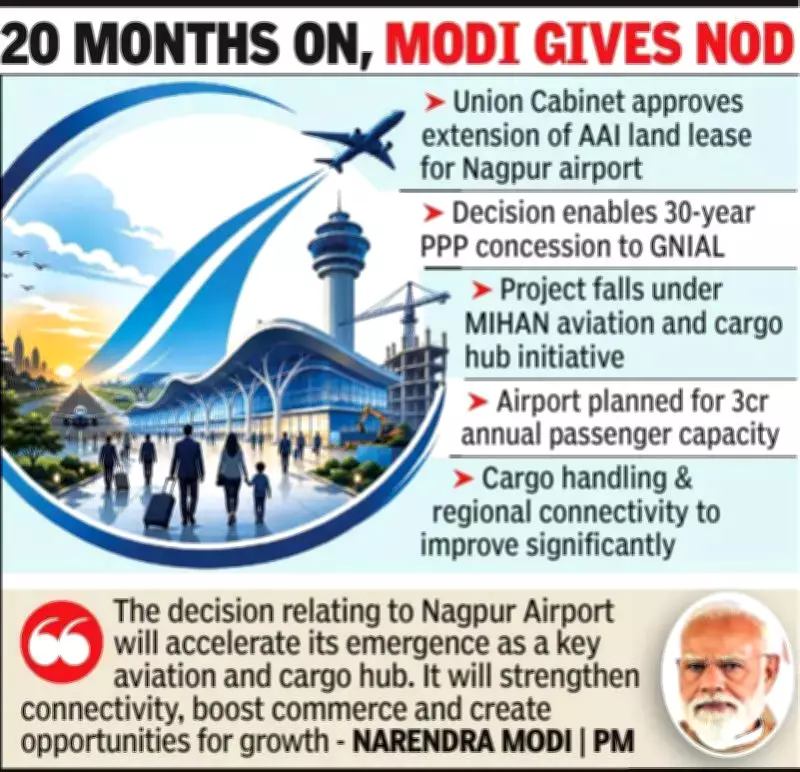
At least 20 months after Prime Minister Narendra Modi performed the groundbreaking ceremony for the expansion and modernisation of Nagpur airport, the Union Cabinet chaired by him cleared the final administrative hurdle on Wednesday. The decision allows the GMR Group to take over operations of the brownfield airport under a public-private partnership model, bringing much-needed clarity to a project set to become a gamechanger for the region. GMR is expected to invest approximately Rs 7,000 crore for the airport's development.
Cabinet Approval and Concession Details
The Cabinet approved the extension of the Airports Authority of India's (AAI) land lease to MIHAN India Limited beyond August 6, 2039. This enables the joint venture company to grant a 30-year concession to GMR Nagpur International Airport Limited (GNAIL) from the commercial operation date. The move effectively ends a prolonged legal and policy battle that stalled one of central India's most ambitious infrastructure projects for over six years.
Revival of MIHAN Vision
The approval is expected to revive the 30-year-old vision of the Multi-Modal International Cargo Hub and Airport at Nagpur (MIHAN). Conceived as an integrated aviation and logistics centre, MIHAN aims to transform Nagpur into a strategic passenger and cargo gateway. Maharashtra Chief Minister Devendra Fadnavis welcomed the Union Cabinet decision, describing it as a turning point for the city's infrastructure ambitions. 'Only a few clearances were pending for the airport transfer. I thank Prime Minister Narendra Modi and the Union Cabinet for approving the project today. We will build a world-class airport in Nagpur,' he told reporters.

Modernisation Plans
Nagpur airport director Abid Ruhi stated that the Centre's approval would significantly accelerate the city's long-term economic development. 'GMR will not only renovate the existing airport but also build a new international-standard terminal. It will construct a second runway and provide facilities comparable to top airports. The second runway will strengthen Nagpur's ambition of becoming a logistics capital,' he said. Currently, Nagpur operates only two international flights despite its designation as an international airport.
End of Legal Dispute
The Cabinet decision closes a contentious chapter that began after GMR Airports Limited emerged as the highest bidder in the airport privatisation process initiated by MIHAN India Limited in 2016. The company initially quoted a revenue-sharing offer of 5.76%, later revised to 14.49% of gross revenue after negotiations. However, the bidding process was annulled in March 2020 during the tenure of the Maha Vikas Aghadi government led by then Chief Minister Uddhav Thackeray, triggering a prolonged legal dispute. GMR challenged the annulment in the Nagpur bench of the Bombay High Court, terming it 'unjust, arbitrary and illegal action'. The High Court ruled in favour of the company, and the verdict was subsequently upheld by the Supreme Court, including in proceedings related to a review petition. The legal battle continued until September 2024 as the state government, then headed by Devendra Fadnavis, pursued the matter in the apex court but lost.
Background of MIHAN
The roots of the project go back to 2009, when MIHAN India Limited was formed as a joint venture between the Airports Authority of India and the Maharashtra Airport Development Company with a 49:51 equity structure. While airport assets were transferred to the joint venture the same year, land lease formalities were delayed due to demarcation-related issues. Government officials said the latest approval aligns the land lease tenure with the full concession period, enabling the formal handover and implementation of the airport modernisation plan.

Expected Impact
The expansion is expected to become one of the largest aviation infrastructure upgrades in central India, combining passenger traffic growth with logistics, cargo and industrial development. The Centre stated that the project reflects its broader infrastructure-led growth strategy and increased private participation in the aviation sector. The modernisation plan, which includes state-of-the-art facilities for international cargo and passenger services, promises to place Nagpur firmly on the map as a strategic logistics hub, enhancing both domestic and international connectivity. The decision also represents a major step forward in the city's infrastructure ambitions and could set the stage for future investment and development in the region, according to MADC officials.





