

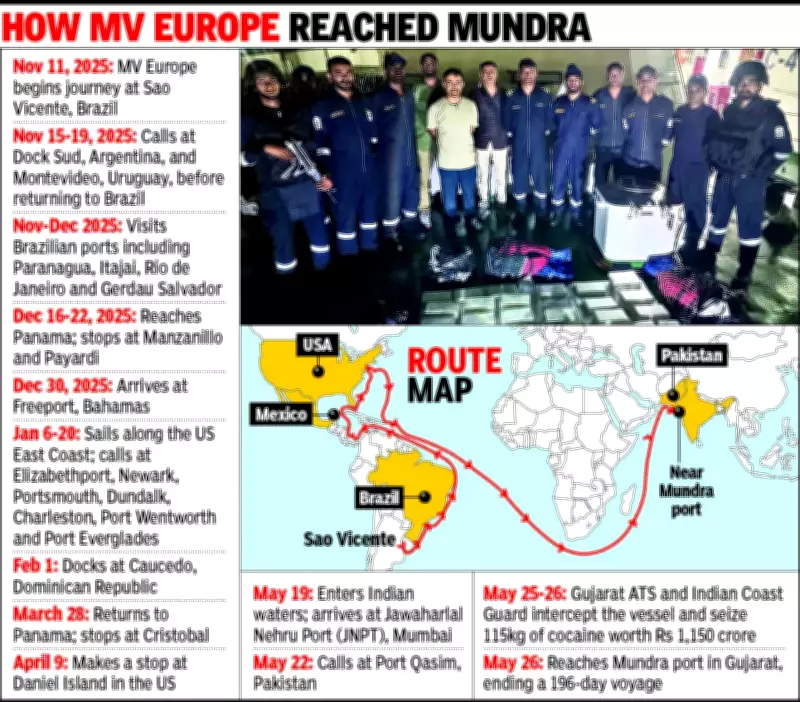
The cargo vessel MV Europe, from which the Gujarat Anti-Terrorist Squad (ATS) and the Indian Coast Guard seized 115 kilograms of cocaine valued at Rs 1,150 crore near Mundra port, had spent approximately 196 days traversing oceans. The ship made 40 recorded stops at 23 ports across seven countries before India's largest maritime anti-narcotics operation concluded its journey.
Complex Maritime Route Uncovered
Senior ATS officers revealed that the investigation uncovered a complex maritime route stretching from South America to India. According to officials, intelligence inputs regarding the cocaine consignment were first received in May of the previous year, when the narcotics were allegedly being packed aboard the vessel and plans were being made to dispatch them through international sea routes.
“The cocaine originated in Brazil and remained concealed inside the vessel’s motor room for several months as the ship moved through multiple jurisdictions before arriving in Indian waters,” a senior ATS officer stated.

Detailed Voyage Timeline
Shipping records examined by ATS officers indicate that the vessel’s first documented stop was at Sao Vicente in Brazil on November 11, 2025. Over the following months, it moved through ports in Brazil, Argentina, and Uruguay before entering the Panama Canal. The vessel later traveled to the Bahamas, the Dominican Republic, and several ports along the eastern coast of the United States.
ATS officials noted that the ship repeatedly revisited certain ports and anchorage points, particularly in Brazil, Panama, and the United States, resulting in 40 recorded port and anchorage stops during the voyage. The vessel eventually sailed towards South Asia, arriving at Jawaharlal Nehru Port near Mumbai on May 19, then proceeding to Pakistan’s Port Qasim on May 22, and finally reaching Mundra on May 26.
Interception and Seizure Operation
Officials said the ship remained at the Mundra anchorage for nearly two days, awaiting another vessel that was supposed to collect the contraband. However, continuous surveillance by the Coast Guard and ATS disrupted the transfer plan. According to ATS, the cocaine was intended to be shifted to another boat in the outer anchorage before being transported inland.
ATS officers suspect that India was not necessarily the final destination of the entire consignment. “There are indications that India could have served as a distribution point. It is an old modus operandi of the drug mafia. The contraband is stocked in a country and later distributed through air cargo in small packets to other countries. We are examining whether portions of the consignment were intended to be routed to other countries through air cargo channels after being brought ashore,” an ATS officer explained.
The seizure followed a midnight interception operation conducted on May 25-26. As Coast Guard teams approached the vessel, crew members allegedly threw bags containing cocaine into the sea. Five bags were recovered, leading to the seizure of 115 packets of cocaine.
Missing Cocaine Packet and Crew Involvement
Sources in Gujarat ATS revealed that the crew of the ship carrying cocaine had thrown some packets into the sea to evade legal action. Questioning has revealed that contents of one packet from the remaining stock were sold en route by the crew. The sources indicated that selling some of the contraband for easy money during its journey is a common practice among smuggling mafia. The investigation is also tracing the money from the said sale.






