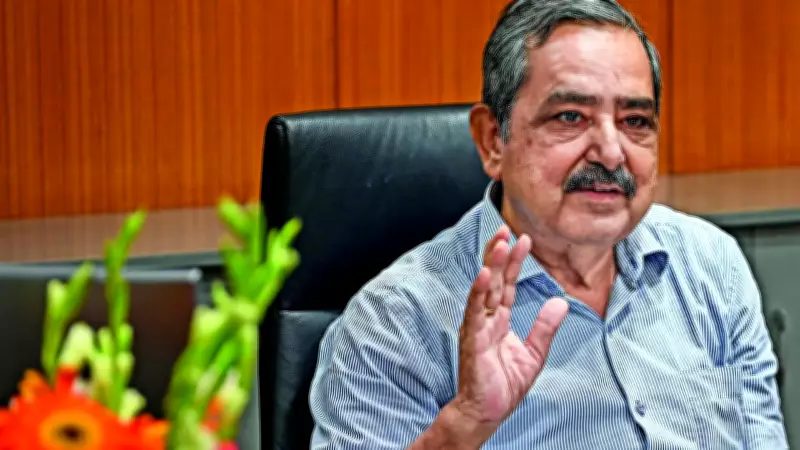
Economist and former Bengal legislator Ashok Lahiri took over as the fourth vice-chairman of NITI Aayog on Friday. In his first interview since assuming the role, Lahiri outlined his priorities while backing a higher gold import duty and suggesting that a broad oil subsidy might ultimately reduce expenditure on education or health. He maintained that the economic situation is not alarming. Below are excerpts from an interview with TOI's Sidhartha.
Impact of West Asia Conflict
Asked about the seriousness of the West Asia conflict's impact on growth, inflation, fiscal situation, and balance of payments, Lahiri said: "It's worrisome, undoubtedly, but if you're running a fever, people around you won't be worried if it's influenza. But if it is typhoid or malaria, then they will be worried. So, in the West Asia crisis also the question is how long will it last? If it ends soon, there's no problem. But if it's prolonged, then the situation is very different. So, we have to err on the side of caution."
He added: "This is not the first time it is happening, there was the first oil price shock and the second. The problem is we are dependent on oil imports, and it is a significant dependence. If this is a sustained problem, every $10 increase in the price of a barrel of crude can increase inflation by 0.5% because petroleum is a universal intermediate. It affects fertiliser, it affects transportation cost, manufacturing is affected."

Macroeconomic Parameters
Regarding the impact on macroeconomic parameters, Lahiri noted: "World Bank, IMF, ADB, RBI have given their projections. Sitting here after taking over in NITI Aayog less than a week ago, I wouldn't hazard a guess. When prices go up, even samosa prices will increase, and you will eat fewer samosas. If inflation picks up, then it affects people's purchasing power, demand will be affected. I see it as a supply shock without us doing anything, the supply side has affected us. In a supply shock by simple geometry, if the supply curve has shifted to the left, then you will find a tendency for growth to be affected and inflation to be high. But I don't think the time has come to ring the alarm bells. PM's appeal to the people makes sense. If prices go up, people will cut down on demand because if they don't, then prices will go up even more and demand will be affected."
Gold Import Duty
On the increased import duty on gold, Lahiri commented: "India has got 18,000 tonnes of gold. Our grandmothers were not rich people, but they were very fond of gold. We import gold and there is so much craze for it. Prices had reached nearly Rs 2 lakh for 10 grams and people thought it would go up even more. Historically, gold has been a poor store of value. Imposing a higher tax on gold is a good idea. PM has been absolutely statesmanlike in his appeal to people to cut down on inessential expenditure. You also need to increase domestic savings because investment flows from household savings and we need investment in the economy. China in its heyday, even South Korea, had a savings rate of over 40%."
Fuel Prices
When asked if it is time to increase retail prices of fuel, Lahiri said: "Since we import most of the petroleum, we have to pay for it. We need to protect the poor and the vulnerable. After spending five years on the ground (as MLA in Bengal), I can say with certainty that a poor man uses petroleum very sparingly: he takes a bus ride instead of a car, he does not use an air conditioner or a washing machine."
Regarding a steep increase in oil prices reducing demand, he added: "The decision has to be taken by govt and oil companies. But it looks inevitable. We shouldn't be cutting education or health budget to provide subsidised oil to everyone."

Rupee Depreciation
On the depreciation of the rupee and its impact on price pressure, Lahiri stated: "During the British Raj, the rulers were very keen to keep the rupee appreciated so that they could sell their products here, and we couldn't compete. Dadabhai Naoroji and RC Dutt used to argue for depreciating the rupee. No one is going to judge India on the basis of the strength of the rupee; let it find its level and RBI is doing the right thing. If you look at east Asia, they have never been so sensitive about the currency. If you want to export, if you want to be competitive in the world market, you need to have a rightly priced currency. If the rupee depreciates, imported products become more expensive. That is for sure."
FDI Inflows
On stepping up net FDI inflows, Lahiri said: "More FDI is welcome. For the country to develop we need a lot more capital and just our domestic savings will not be good enough. The US used to import capital and Europe used to provide that. Due to the current crisis and the uncertainty, investors are shy. We have taken several steps on ease of doing business, and more measures have been listed by govt. I have this obsession for five things: education, health, physical infrastructure, proper social welfare system, where the vulnerable and the poor get benefits, and a corruption free administration with proper law and order. We have made a lot of improvement on all aspects, but we can do much more, which will also excite investors. There may also be some information problem: foreign investors may not know what brilliant prospects await them if they move 30 km from Muzaffarpur, to get even better litchis."
Areas of Focus
When asked if these five areas would be his focus as vice-chairman, Lahiri replied: "I'll be guided by govt and the other members. What we discussed yesterday with the staff and our members is an ongoing discussion."
NITI Aayog Structure
On the need to revamp NITI Aayog's structure after more than a decade, he said: "I and the others are engaged with it and I don't want to pronounce a judgment on that right away. I don't think restructuring is a one step process, it's continuous. A think tank is as effective as its thoughts are implemented. I'm a believer in impact analysis. The issue is to make NITI Aayog more effective and more impactful. There's a lot to be done and it's a challenge, mind you, because we give advice, we don't give money, and advice without money has to be good for it to be caught on."
Disinvestment and Asset Monetization
Regarding disinvestment and asset monetization under fiscal pressure, Lahiri stated: "Of course. But having said that, you also have to avoid distress sales. I mean if you can sell your house for Rs 20 lakh today and you know that the day after tomorrow you will be able to sell it for Rs 30 lakhs then there is no reason to sell it now. But the problem is those who do not want to sell will always say 'bhao badhega ji'. I'm a great believer in increasing the rate of return from govt's investment, particularly because when the cost of borrowing from the market is 7% and your investment is not giving a rate of return of 7%, it doesn't make sense to hold on. Many other things can be done with that money with much higher social return."
On announced measures, Lahiri concluded: "We are following the govt's advice, whatever can be done online, we do online and in any case it's too early for me to travel."