

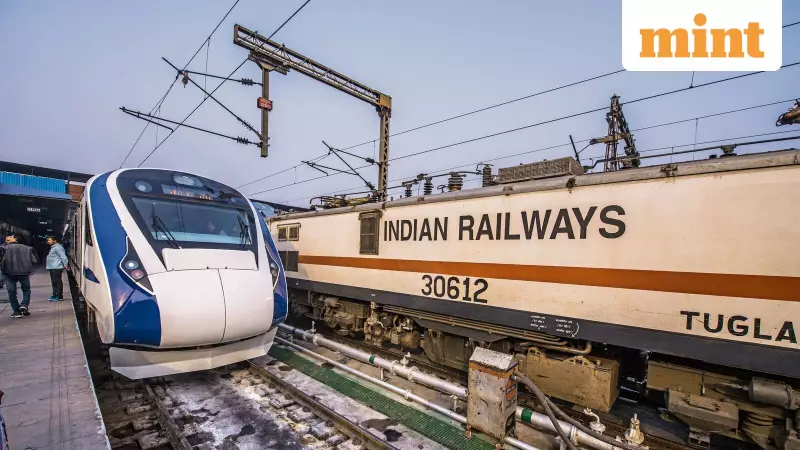
Indian Railways finds itself at a familiar crossroads, caught between its role as a commercial entity and its social obligations. The recent, moderate increase in passenger fares, effective from 26 December 2025, highlights a persistent financial dilemma that continues to burden the national transporter.
The Populist Pattern of Fare Revisions
The latest revision, the second in the 2025-26 fiscal year, follows a long-established pattern. The hikes are largely confined to air-conditioned and non-AC classes on mail and express trains. Critically, fares for suburban services, monthly season tickets, and ordinary-class travel for distances up to 215 kilometres have been left untouched. The increase itself is nominal, at just two paise per kilometre for higher classes and about one paise for ordinary class beyond 215 km.
This selective approach is rooted in political populism. The last revision for suburban fares was attempted in 2014 but was partially rolled back following public protests. Historically, governments have consistently prioritized social objectives over profitability, influencing everything from route planning to ticket pricing. The estimated additional revenue of ₹600 crore from this hike, while welcome, is a drop in the ocean for an organization of IR's scale.

A Grim Financial Picture: The Operating Ratio Problem
The core of the issue lies in Indian Railways' strained finances, as starkly outlined in the Fifth Report of the Parliamentary Standing Committee on Railways from August 2025. The report notes that the Operating Ratio (OR) has remained above 98% since 2022-23. An OR above 100% means spending more than you earn. With an OR hovering near 98%, almost every rupee earned is spent on operations, leaving negligible internal funds for crucial capital investment like new tracks, rolling stock, and safety upgrades.
This forces IR to rely heavily on budgetary support or borrowings, which in turn increases its interest burden, creating a vicious cycle. The Standing Committee's December 2024 report explicitly recommended a better alignment of fares with operational costs across all classes, including the politically sensitive suburban travel segment.
The Subsidy Conundrum and the Path Forward
There is no denying Indian Railways' monumental social and economic role. It acts as the nation's lifeline, carrying around 20 million passengers daily (and up to 30 million during festivals), integrates the country, and supports economic activity with affordable transport. However, the system of deep subsidies, or 'freebies,' is unsustainable.
A comparison illustrates the stark under-pricing: a Vande Bharat seat from Delhi to Varanasi costs roughly $21-40, while an Amtrak ticket for a slightly shorter distance from Washington DC to Boston ranges from $200 to $500. Weaning a nation accustomed to subsidized travel is politically challenging, but essential. The successful deregulation and subsidy management in India's oil sector offer a potential blueprint for gradual, phased reform.
Without a concerted effort to rationalize fares progressively across all segments, Indian Railways will continue to have a high Operating Ratio, fail to generate enough internal capital for investment, and remain a significant fiscal burden. Financial soundness is not just about profit; it is about ensuring the railway's future viability and capacity to serve the nation effectively.






