

Panic Fuel Buying Grips Gujarat as Rumors Spark 118% Surge in Petrol Sales
Ahmedabad witnessed unprecedented scenes at petrol pumps this week as panic refuelling, driven by baseless rumors of an impending fuel shortage, caused sales to more than double in a single day. The frenzy, which began on Monday afternoon, spilled over into Tuesday, creating serpentine queues and major traffic disruptions across the state.
Staggering Sales Figures Reveal Extent of Panic
According to estimates from oil companies, state-wide petrol sales on Monday skyrocketed to 17,798 kilolitres against an average daily sale of 8,150 kilolitres. This represents a dramatic increase of 118%. Diesel sales followed a similar pattern, rising to 26,935 kilolitres compared to the usual 16,120 kilolitres, marking a 67% increase.
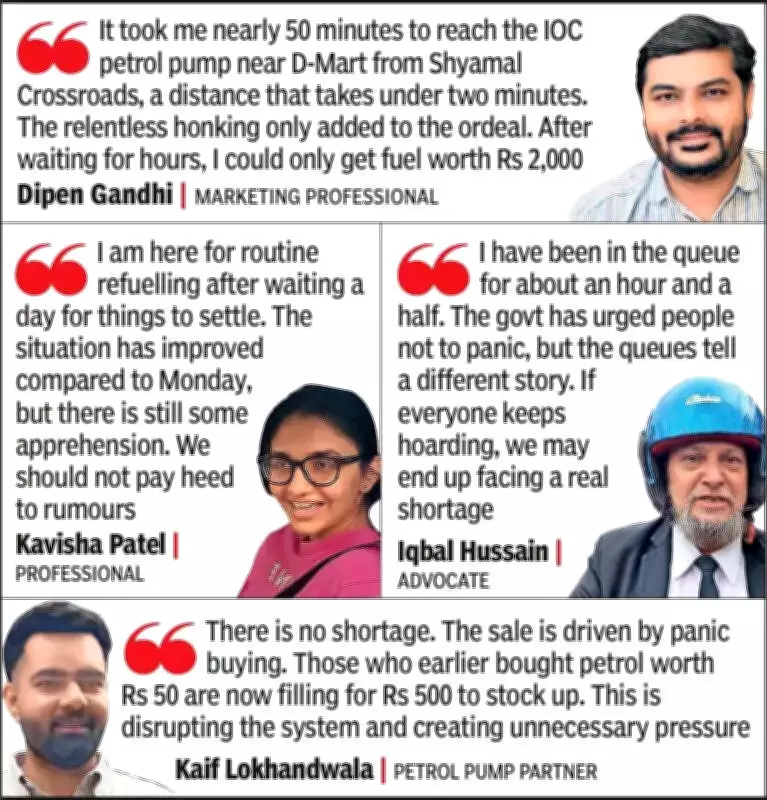
"The majority of customers are asking for full-tank refills, anticipating an impending shortage purely based on rumors," explained Padmajay Rathod, a petroleum dealer from Ahmedabad. "The staff is hassled as a result. If this continues, any petrol pump could run dry, which may further fuel panic."

Ahmedabad Ground Zero for Fuel Frenzy
In Ahmedabad, major rush was reported at fuel stations throughout Tuesday in areas including Gulbai Tekra, Shivranjini, Jodhpur, Anandnagar Road, Prernatirth Derasar Road, Mithakhali, Prahladnagar, and Navrangpura. While queue intensity reduced slightly through the day, the situation remained far from normal.
Bankim Banerjee, a professional who works in Ambawadi, shared his experience: "Having made two trips to a fuel station near my office, I ended up waiting almost 40 minutes to refuel my car. I had no intention of going to the fuel station during such rush hours, but due to a few work trips during the day, my car ran out of fuel, and I had no choice."
Traffic Chaos and Outlet-Level Spikes
The frenzied buying led to significant traffic snarls across several road stretches with fuel stations. At the individual outlet level, the spike was even more pronounced, with several petrol pumps reporting sales of four to five times their daily average volumes.
Official Reassurances Amid Continuing Anxiety
Public sector oil companies have repeatedly emphasized that supply remains robust despite the panic buying. Sanjib Kumar Behera, executive director and state head of the state-level coordination committee for PSU oil companies in Gujarat, provided specific figures: "Our average daily petrol sale in Gujarat is 3,000 kilolitres per day. But on Monday, our fuel stations across the state sold 7,917 kilolitres of petrol as the demand suddenly shot up due to the rumors of fuel shortage."
Behera added reassuringly: "There is adequate pipeline stock, and refineries are operating at full capacity. Our staff are working round the clock to ensure uninterrupted supply and to reassure consumers that there is no shortage."
Panic Spreads to Other Cities
The fuel frenzy was not confined to Ahmedabad. In Vadodara, serpentine queues of vehicles and impatient honking became commonplace on Tuesday as panic buying continued for the second consecutive day despite repeated government assurances.
Even as the district administration urged people not to panic, crowds continued to throng fuel stations. At some pumps, attendants were forced to ration supply. The situation became particularly concerning as several of the city's 163 fuel stations temporarily shut after running out of stock.
"Around 30% of the fuel stations in the city were closed, but their stocks will be replenished soon," said Mehul Patel, president of the Federation of Gujarat Petroleum Dealers Association.
In Rajkot, the rush eased compared to Monday, though many fuel stations continued to witness queues and heavy sales throughout Tuesday.
Industry Warns Against Precautionary Buying
Industry officials have clarified that the surge was entirely driven by precautionary buying rather than any genuine supply constraint. They warned that such behavior risks creating temporary localized shortages that would not otherwise exist.

The timeline of events reveals how quickly rumors can translate into action. Estimates show that fuel sales remained normal through Monday morning before surging sharply after 2 PM. Queues began swelling late on Monday night itself, and by Tuesday morning, office-goers once again crowded pumps across multiple cities.
As the situation gradually normalizes, authorities continue to emphasize that there is no actual fuel shortage and that the distribution system remains fully operational to meet regular demand patterns.





