

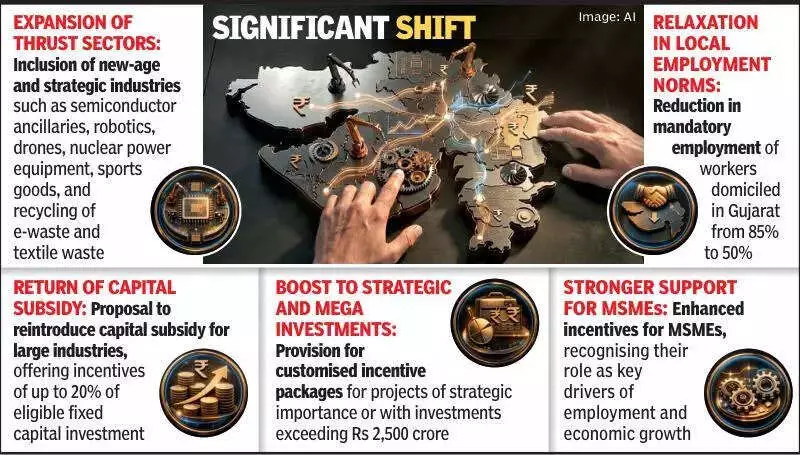
In a major move to attract next-generation investments, the Gujarat government is set to announce a revamped industrial policy that will introduce significant incentives and expand its focus to cutting-edge sectors. The policy, expected to be unveiled in the coming days, marks a strategic shift to align the state's offerings with national peers and global trends.
New Thrust Sectors and the Return of Capital Subsidy
The forthcoming policy will designate several new-age and strategic industries as "thrust sectors." These include ancillary units for semiconductor manufacturing, robotics, drone manufacturing, and nuclear power equipment production. This expansion reflects the state's ambition to move up the technology value chain.
In a significant reversal, the policy is also likely to reintroduce capital subsidy for large industries after a long hiatus. Currently, this benefit is largely restricted to micro units. Under the new framework, large projects across a wide range of sectors could receive incentives of up to 20% of their eligible fixed capital investment, with even higher benefits for projects located in underdeveloped talukas.

Custom Packages and Relaxed Employment Rules
To attract mega-investments, the government proposes customised incentive packages for companies investing more than Rs 2,500 crore or operating in sectors of strategic importance. A high-powered committee, chaired by the state's chief secretary, will be empowered to grant approvals for these tailored deals.
Addressing a long-standing demand from industry, a related aerospace and defence policy in its final stages incorporates a major relaxation in local hiring norms. The mandatory employment of Gujarat-domiciled workers is proposed to be reduced from the current 85% to 50% of the total workforce, providing companies with greater flexibility in talent acquisition.
Broadening the Industrial Base for a Global Stage
Aligning with Gujarat's hosting of the Commonwealth Games in 2030 and its active bid for the 2036 Olympics, sports goods manufacturing has been proposed as a new thrust sector. The policy also aims to boost traditional and emerging segments by adding toy manufacturing, blue economy activities, footwear and leather, vehicle scrapping, and the recycling of electronic and textile waste.
Recognising MSMEs as the backbone of the state's economy and employment, the policy promises to strengthen incentives for this sector. An industry association office bearer welcomed the proposed changes, stating that while Gujarat is a manufacturing powerhouse, competing states have been offering more attractive incentives. The reintroduction of capital subsidy is expected to drive significant new investments into the state.
Sources indicate that final modifications to the draft policy may still be made before its formal announcement, setting the stage for Gujarat's next phase of industrial growth.






