

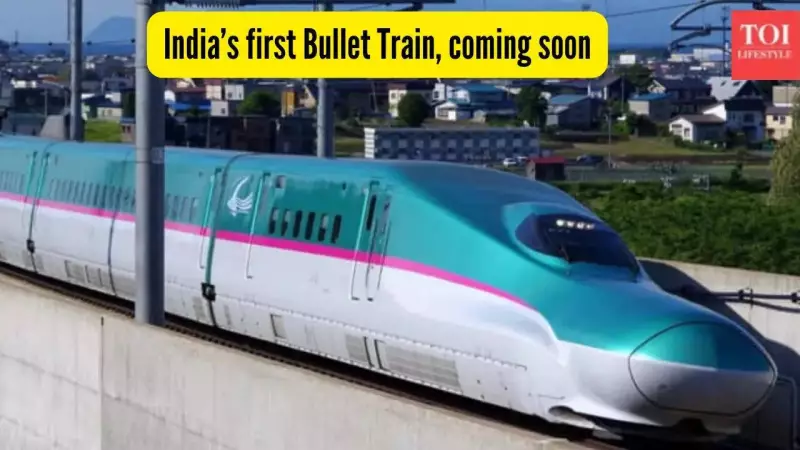
Indian Railways is poised for a historic leap into the future of travel with the imminent launch of the nation's first high-speed bullet train system. The Mumbai–Ahmedabad High-Speed Rail Corridor (MAHSR) represents a monumental shift in India's transportation landscape, promising to redefine intercity connectivity.
Official Launch Date and Initial Operations
In a significant announcement, the Ministry of Railways and Union Railway Minister Ashwini Vaishnaw have confirmed the official launch date. The first bullet train service is scheduled to commence operations on August 15, 2027, coinciding with India's Independence Day celebrations. The inaugural run will operate on a 100-kilometer stretch between Surat and Vapi in Gujarat, marking the beginning of a new era.
Engineering Marvel and Route Details
This ambitious corridor stretches over 508 kilometers, seamlessly connecting the financial hub of Mumbai, Maharashtra, with the economic powerhouse of Ahmedabad, Gujarat. The project is designed to international high-speed rail standards and features remarkable engineering feats. The route will include a series of tunnels, most notably a 21-kilometer underground tunnel and a groundbreaking 7-kilometer undersea section beneath Thane Creek.

The corridor will be served by 12 strategically located stations:
- In Maharashtra: Bandra Kurla Complex (BKC), Thane, Virar, Boisar.
- In Gujarat: Vapi, Bilimora, Surat, Bharuch, Vadodara, Anand, Ahmedabad, and Sabarmati.
Technology, Speed, and Economic Impact
Developed in collaboration with Japan, the corridor will utilize cutting-edge Japanese Shinkansen E5 series trains. These trains are capable of reaching operational speeds of up to 320 km per hour. This immense speed will dramatically reduce travel time, enabling passengers to commute between Mumbai and Ahmedabad in under three hours, a stark contrast to the current 7–8 hour journey by conventional rail.
Once fully operational, services are planned to run frequently, with trains departing every 15 to 20 minutes. This high-frequency service is expected to act as a catalyst for regional economic growth, boosting business, tourism, and development along the corridor. The project is a landmark initiative that blends world-class technology with domestic execution, signaling a major upgrade to India's railway infrastructure. The system is expected to achieve full operational capability by 2029.






