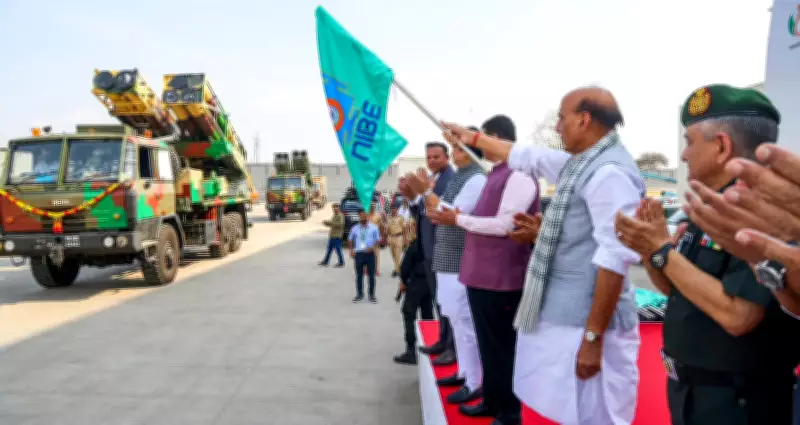
Defence Minister Rajnath Singh on Saturday inaugurated a defence manufacturing complex of NIBE Group at Shirdi in Maharashtra's Ahilyanagar that will produce advanced artillery systems, missile and space technologies, rocket systems, energetic materials, and autonomous defence platforms.
The minister, along with Maharashtra Chief Minister Devendra Fadnavis, also flagged off the country's first 300km universal rocket launching system 'Suryastra', which was recently tested at Chandipur integrated test centre off Odisha. He said the artillery shell plant will have an annual production capacity of 5 lakh shells. Stressing the importance of self-reliance in ammunition production, Rajnath said this is the land of Shivaji, and inspired by Chhatrapati Shivaji Maharaj, India is building a 'fortress of self-reliance' in the defence sector in Maharashtra.
He expressed confidence that the complex will help fulfil the operational requirements of the defence forces and bolster the industrial ecosystem of the country. He stated that defence production, which was earlier largely confined to public sector units and ordnance factories, has been opened to the private sector by his government. 'We recognised the capabilities of the private sector as it can transform India into a global manufacturing hub,' he said.

Praising NIBE Group CMD Ganesh Nibe, Rajnath said, 'After seeing this facility, I can say with certainty that no power in the world can stop India from becoming the world's largest exporter in the defence sector in the next 25-30 years. Today, a golden chapter is being written in India's defence and space sectors.'
Rajnath also laid the foundation stone for a missile complex and unveiled indigenous TNT plant technology, RDX plant technology, and renewable bio-energy compressed biogas plant. An MoU was exchanged between NIBE Group and US-based space intelligence and geospatial data company Black Sky in the field of satellite assembly.
The minister said the plants inaugurated on Saturday are poised to become research-oriented hubs, further bolstering India's defence capabilities. He hoped that the missile complex for the universal rocket launching system will provide a new direction to India's future warfare capabilities. 'Powered by indigenous technology, this rocket system will multiply our strike capability manifold and prove to be a strategic game-changer,' he said.
He appreciated that the complex will create a vast ecosystem not just for high-technology industries, but also for MSMEs, small-scale industries, and the local economy. 'There was a time when private sector contribution in defence production was negligible. It has now reached 25-30%. Our objective is to take this figure to 50% in the coming years. This is the new India where the private industry is not merely a supplier of nuts and bolts, but is emerging as the innovator and manufacturer of state-of-the-art weapon systems,' Rajnath said.
Rajnath, who also visited the Shirdi temple, emphasised that the outcome of future wars will be determined by advancements in munitions and automation, not by the size of forces. 'Glimpses of this reality can be witnessed in the ongoing Russia-Ukraine conflict and the West Asia situation. India demonstrated this capability during Operation Sindoor,' he said.
Calling for concerted efforts to transform India into a global hub for munitions and automation, the minister said, 'We stand ready to take every necessary step to ensure that India emerges as a frontrunner in munitions and automated systems.'
Rajnath underlined that the fundamental objective of technology is not to diminish soldiers' capabilities but to augment them, and the final decision must always remain in human hands. He said modern weaponry and automated systems are playing an increasingly significant role in future warfare, and it is imperative for India to advance in this direction. 'Let us collectively pledge to make India completely self-reliant in defence and space technology,' he said, urging defence companies to enhance India's capabilities for future wars. He asserted that 'security' and 'economy' can no longer be viewed in isolation, as a robust economy serves as the bedrock for a strong military and modern defence capabilities.