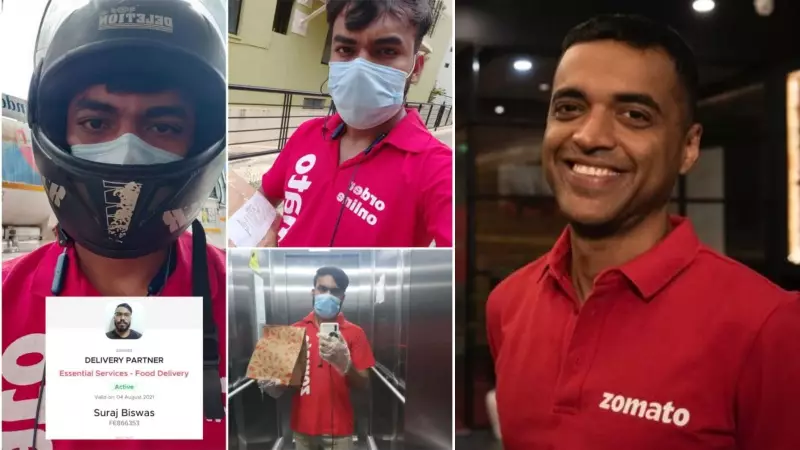
A Bengaluru-based entrepreneur who once delivered food for Zomato has stepped into the heated debate on gig work, offering a unique perspective shaped by his personal journey from a delivery rider to the founder of a deep-tech company.
From Food Delivery to Founding a Startup
Suraj Biswas, the founder and CEO of Assessli, recently took to LinkedIn to share his experience. He revealed that during 2020–21, before diving into college and launching his startup, he worked as a delivery partner for Zomato in Bengaluru. He framed this period not as a hardship but as one of "independence, dignity, and opportunity."
Biswas credits the gig with funding his education, supporting his early startup team, and maintaining his financial independence. Today, his company Assessli employs over 40 people across Bengaluru and Kolkata.

High Earnings and the Power of Technology
Challenging common narratives about low pay, Biswas disclosed his own monthly earnings were around Rs 40,000. More strikingly, he said he personally knew riders who made between Rs 80,000 and Rs 90,000 per month.
He highlighted the sector's low barriers to entry. "No degree checks. No background privilege. Just effort + tech + execution," he wrote. He also acknowledged the job's risks, recalling incidents of food theft and dangerous situations, but noted Zomato's medical insurance and emergency support were crucial. This exposure to large-scale tech systems, he said, influenced his path as a tech founder.
A Defence of Flexibility and a Critique of Bans
Weighing in on debates about rapid delivery and worker conditions, Biswas argued that gig work is inherently voluntary and flexible. "This was independent gig work, not forced labour," he stated, pointing out that many riders work across multiple apps simultaneously.
He questioned the viability of a fixed-salary, exclusive employment model for delivery platforms, suggesting "Loyalty in gig work is flexibility-driven, not contract-driven." He also criticised calls for bans on such models, arguing they don't solve unemployment. "What actually solves unemployment? Not bans. Not outrage. Not unrealistic expectations," he wrote, advocating instead for more tech platforms that create income opportunities without formal credentials.
In his view, Zomato "delivered economic mobility at scale," helping students, migrants, and millions work on their own terms. He concluded with a firm stance: "So yes, unapologetically, I stand with Zomato. I stand with Deepinder."
The Economics of Supply and Demand
In a follow-up comment, Biswas provided an economic analysis to explain why rider earnings might have fallen. He noted that while Zomato had about 1.7 lakh delivery partners in 2020–21, the combined active partners on Zomato and Blinkit today are roughly 7.5–8 lakh—a four to fivefold increase in supply.
However, demand growth has been slower. Orders grew from approximately 647 million in FY23 to an estimated 850 million in FY25, a rise of about 30–35%. "If supply grows 400–500% but demand grows only 30%, orders per delivery partner must fall," he reasoned, attributing lower average earnings to this imbalance rather than platform failure.
His post sparked significant online discussion, with many praising the ground-level perspective. One user commented that it was a "real life story of perseverance and grit," while another noted, "This is where lived experience matters more than armchair opinions."