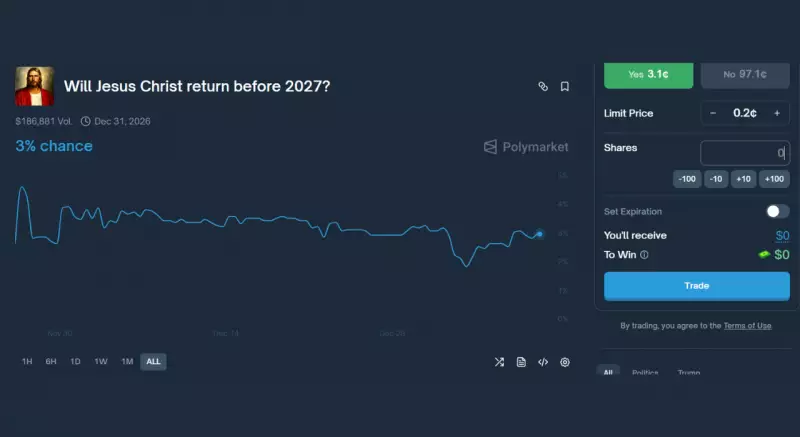
In a fascinating fusion of ancient faith and modern finance, a digital prediction market is allowing traders to place monetary bets on one of Christianity's most profound beliefs: the Second Coming of Jesus Christ. The specific contract on the Polymarket platform asks whether Christ will return to Earth before the deadline of 11:59 PM ET on 31 December 2026.
The Mechanics of a Divine Wager
This is not the first time such a bet has appeared. A nearly identical contract ran through 2025, attracting close to $3.3 million in trader commitments, with the vast majority betting against the event occurring. That market formally resolved to "No" when the new year arrived without incident. The current contract for 2026 operates on the same principle. Traders buy "Yes" or "No" shares tied to the outcome. A "Yes" share pays out $1 if the event happens within the timeframe; otherwise, it becomes worthless.
As of now, the market strongly favours a negative outcome. The implied probability of Jesus Christ returning by the end of 2026 stands at roughly 3%. This means a successful bet on "Yes" could yield a staggering potential return of over 5,700%. For those on the "No" side, the trade has functioned as a surprisingly stable, low-volatility instrument. During the 2025 market, the "No" bet delivered an estimated annualised return of about 5.5% before fees during a period of peak interest, quietly outperforming US Treasury bills.

Faith, Probability, and Pascal's Legacy
The act of applying odds to religious belief is not a new phenomenon. In the 17th century, French mathematician and philosopher Blaise Pascal formulated his famous pragmatic argument, now known as Pascal's Wager. He framed belief in God as the rational choice under uncertainty, offering infinite reward if correct for a finite earthly cost if wrong. However, Pascal never suggested this belief could be financially priced or traded.
The Polymarket contract takes a narrower, more clinical approach. It does not ask participants to believe or disbelieve. Instead, it asks them to assign a probability to a specific, time-bound outcome and risk money on that assessment. This reduction of a scripturally unknowable event, held sacred by billions, to a fluctuating digital price is what has drawn significant attention and criticism.
Criticism and Trader Motivation
The market has sparked debate. Some academics, like John Holden, an associate professor at Indiana University, compare participation to buying lottery tickets—an action not reflecting belief in the outcome. Others are more critical. Melinda Roth of Washington and Lee School of Law called the wager "distracting" and argued it diminishes the value of prediction markets that provide genuine insights.
Despite the theological subject, for most traders, the appeal is mechanical, not spiritual. The contract offers a clear resolution date, a heavily favoured outcome (“No”), and low volatility on that side. This makes it attractive for parking capital, hedging other positions, or exploiting tiny pricing inefficiencies. The extreme improbability of the event is an asset, making the "No" trade appear predictable and rewarding those who bet against it.
The market remains overwhelmingly one-sided, with approximately 97% of positions backing "No". The rules are clear: the outcome will be determined solely by the passage of time to the deadline, not by any religious authority or declaration. As the countdown to December 2026 continues, traders watch the odds fluctuate by fractions of a percentage point, monitoring a bet that sits at the unlikely intersection of prophecy and probability.