

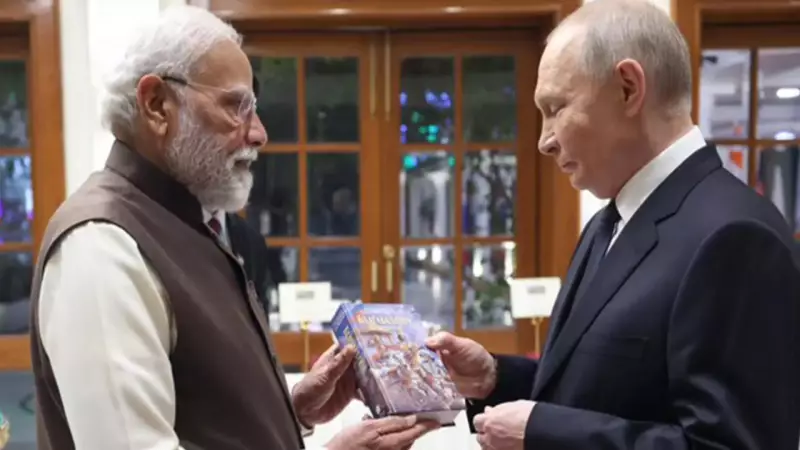
In a significant move to deepen economic ties, Prime Minister Narendra Modi and Russian President Vladimir Putin have instructed their respective teams to speed up negotiations on a crucial bilateral agreement aimed at promoting and safeguarding investments. This directive was a central outcome of the high-level summit held between the two leaders in New Delhi on Friday.
Accelerating Economic Partnerships
The push for a "mutually beneficial" investment promotion and protection agreement underscores a shared commitment to creating a more secure and predictable environment for businesses from both nations. According to a joint statement issued after the talks, the leaders emphasized the need to intensify efforts in these negotiations, recognizing its importance for future economic collaboration.
Beyond investments, the discussions also covered the broad spectrum of the energy partnership, which includes cooperation on oil, natural gas, refining technologies, and related infrastructure. Both sides expressed satisfaction with the progressing work towards a Free Trade Agreement (FTA) on goods between India and the Eurasian Economic Union (EAEU), a bloc comprising Russia, Armenia, Belarus, Kazakhstan, and Kyrgyzstan. The first round of formal talks on this FTA was held last week.

Addressing the Trade Imbalance
A major focus of the summit was on expanding bilateral trade in a "balanced and sustainable manner." While two-way goods trade reached nearly USD 70 billion in the last financial year, it is heavily skewed in Russia's favour, leaving India with a substantial trade deficit of about USD 59 billion. This imbalance is largely driven by India's substantial imports of Russian crude oil.
To rectify this and achieve a revised bilateral trade target of USD 100 billion by 2030, the leaders agreed on a multi-pronged strategy. This includes boosting India's exports to Russia, addressing tariff barriers, removing logistical bottlenecks, and ensuring smoother payment mechanisms. Crucially, both nations reaffirmed their commitment to using national currencies—the rupee and the ruble—for bilateral settlements to ensure uninterrupted trade flows.
Boosting Connectivity and Specialized Cooperation
Enhancing physical connectivity emerged as another key pillar of the talks. Modi and Putin agreed to deepen collaboration on major transport corridors, including the International North-South Transport Corridor (INSTC), the Chennai-Vladivostok maritime link, and the Arctic's Northern Sea Route. These initiatives aim to strengthen logistics and infrastructure links between the two countries.
In a specialized development, the two sides welcomed the signing of a Memorandum of Understanding (MoU) for training specialists to operate ships in polar waters, highlighting the niche areas of their growing partnership.
The summit outcomes signal a strong intent from both New Delhi and Moscow to institutionalize and future-proof their economic relationship, moving beyond current trade patterns to build a more diversified and resilient partnership for the coming decade.






