

Surat's Solar Ambitions Hampered by Technical Hurdles
While remote regions of Gujarat have long grappled with poor network connectivity, the issue has now crept into areas surrounding Surat, the bustling Diamond City. This technological setback is particularly impacting residents who have embraced modern infrastructure, such as solar power installations and smart meters, leading to widespread confusion and frustration over electricity billing.
Confusion Over Bills and Data Transmission Failures
In November, Hardik Lad, a mechanical engineer from Sithan village located approximately 10 kilometers from Surat, installed a solar plant at his home with high expectations of reducing his power bills. Encouraged by the potential savings, he also opted for a smart meter as part of a billing upgrade by Dakshin Gujarat Vij Company Ltd (DGVCL), which replaced his functional digital meter. However, this move has backfired, leaving Lad in a quandary.
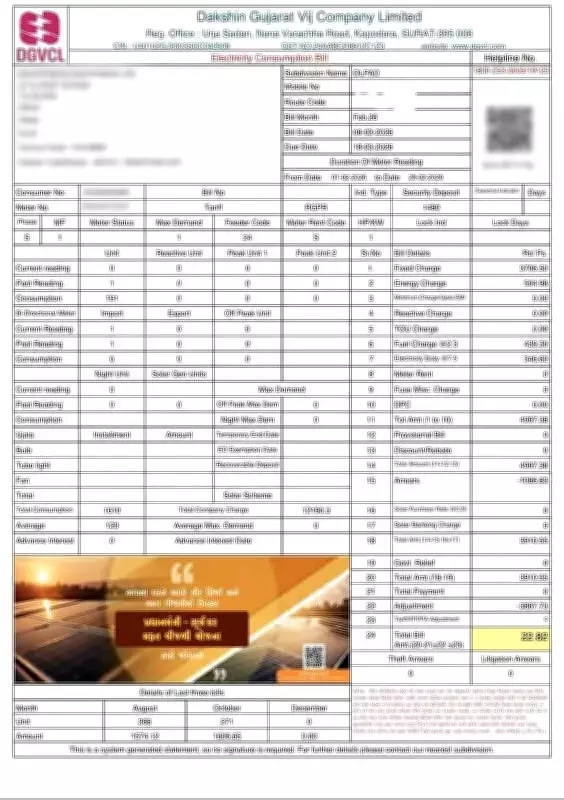
After the installation, users like Lad are not receiving clear details about their actual electricity usage and charges. Bills display adjustment amounts without any explanatory notes, creating significant opacity. For instance, Lad's March bill listed fixed charges, energy charges, fuel charges, and electricity duty totaling Rs 4,997, but the payable amount was only Rs 22 due to an adjustment of Rs -3,887. "I could not understand initially how much electricity the solar plant is producing and how much we are using," Lad explained. "We were told that it would regularize after some time. But despite changing two mobile SIM cards in the meter by the service provider, the meters are unable to transmit data."

Lad has also raised concerns about the accuracy of data recording by these meters. Despite lodging multiple complaints, he has yet to receive a viable solution. Prior to the solar installation, his electricity bills typically ranged between Rs 1,200 and Rs 3,000 for two-month periods, highlighting the current billing anomalies.
Widespread Issues and Manual Interventions
Another Sithan resident, Atul Lad, a factory manager, is encountering similar challenges. "After the installation of the solar power plant and smart meters, I was hoping that I would be able to save well on electricity," he said. "Savings are there, but with uncertainty as I do not know how much electricity I produce and how much is used."
When a solar power plant is set up, DGVCL installs two smart meters: one for electricity production and another for consumption. These meters are designed to transmit data to a server, which should then be accessible via a mobile app, allowing users to monitor daily production and consumption. However, network connectivity issues are disrupting this process.
A DGVCL official acknowledged the problem, stating, "There are issues related to network connectivity and in some cases, we have to carry out manual reading. We are not charging any additional amount in such cases and attempts are on to resolve the problem." In response, DGVCL staff are visiting affected locations to collect data manually, which is then fed into the system to generate bills. A senior official added, "If there are similar issues, we will investigate them and resolve them. It is important to find out why there is an issue."
Industrial Sector Also Affected
The problem extends beyond residential areas to the industrial sector. Vimal Anghan, owner of a textile weaving unit at Anjani Industrial on the outskirts of Surat, installed a 65 kV solar power plant in August but has not seen a corresponding drop in his bills. "I have a 65 kV solar power plant installed at my unit and even now average power bills are being issued," Anghan said. "I believe I am not getting the full deduction for power generated." This indicates that the billing discrepancies are not isolated to individual households but are affecting commercial operations as well, potentially undermining confidence in renewable energy investments.

The persistence of these issues underscores a critical need for DGVCL to enhance its technological infrastructure and communication with consumers. As Surat and its surrounding areas continue to adopt modern energy solutions, resolving these network and smart meter glitches is essential to ensure that the benefits of solar power are fully realized without unnecessary financial and operational burdens on residents and businesses alike.





