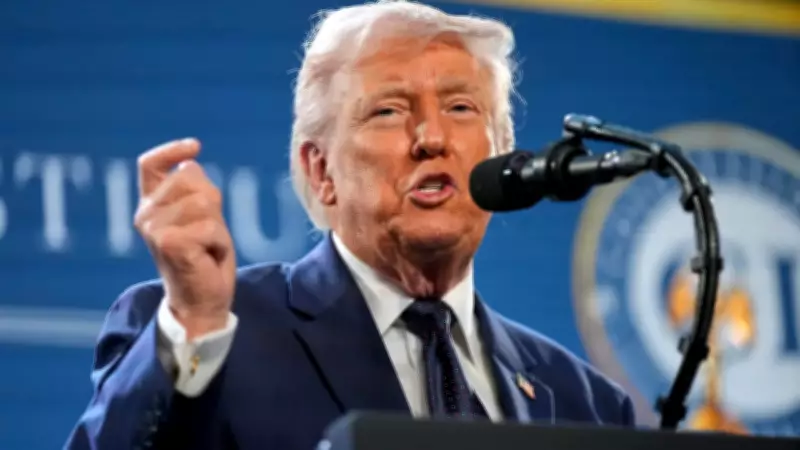
Trump Announces Historic $300 Billion Energy Deal with India's Reliance for Texas Oil Refinery
In a move that has sent shockwaves through the global energy sector, former U.S. President Donald Trump declared on Tuesday that the United States will construct its first new oil refinery in half a century, backed by a monumental $300 billion investment from India's Reliance Industries. Trump, in his signature grandiose style, proclaimed this as a return to "America is returning to real energy dominance," hailing it as the largest energy investment in American history.
A Strategic Partnership Amid Geopolitical Tensions
Beyond the hyperbole, this announcement marks an extraordinary development: a major new refinery planned for the Port of Brownsville, Texas, with a leading investor from India. This comes at a time when India is skillfully navigating complex oil relationships with Russia, Iran, and the U.S. The project represents a rare fusion of geopolitical maneuvering, energy economics, and high-stakes billionaire diplomacy, linking Trump with India's wealthiest family, the Ambanis.
The proposed facility, operating under the "America First Refining" banner, is designed to process American shale crude and export refined products like gasoline, diesel, and jet fuel. If realized, it would address a critical structural issue in the U.S. energy system: the nation produces abundant light shale oil, but many existing refineries are outdated and built to handle heavier imported crude.

Why Reliance? The Jamnagar Blueprint
More intriguing than the refinery itself is the choice of partner. Reliance Industries, controlled by Mukesh Ambani, is not just any foreign investor. It operates the world's largest refining complex in Jamnagar, Gujarat, and has earned a reputation as one of the most technically advanced refiners globally. To grasp why Reliance is the ideal partner for this Texas venture, one must look back to the late 1990s in Jamnagar.
Against all odds and contrary to expert advice citing a lack of infrastructure, Reliance, under the guidance of Dhirubhai Ambani, constructed the world's largest grassroots oil refinery. This massive 1.24 million-barrel-per-day facility transformed India from a fuel-deficit nation into a global export hub, despite the country's lack of domestic oil reserves.
The Jamnagar Refinery's uniqueness lies in its Nelson Complexity Index (NCI) of 21.1—the highest globally—enabling it to process heavy, sour, and cheap crudes from sources like Venezuela and Iran into premium fuels meeting strict environmental standards. This technical prowess turned Reliance into a refining powerhouse and Mukesh Ambani into a legendary figure known for achieving the impossible on tight timelines.
In Brownsville, the U.S. is not merely acquiring capital; it is adopting the "Reliance Blueprint" to solve its own refining mismatch. In return, Reliance and India gain a "Jamnagar West," extending their global influence.
Dynastic Diplomacy and Geopolitical Calculations
The alliance between Trump and the Ambanis, dubbed "Donesh Trumpani," is fueled by dynastic diplomacy that has been brewing for years. It began with Ivanka Trump's 2017 visit to Hyderabad, where she first met Mukesh Ambani. By March 2024, Ivanka and Jared Kushner were personal guests at the Ambani pre-wedding celebrations in Jamnagar. Donald Trump Jr.'s 2025 visit to the Ambanis' animal conservation project in Gujarat further solidified ties between the heirs of both empires.
This deal emerges amid extreme geopolitical tension. For two years, Washington has pressured New Delhi to halt purchases of discounted Russian oil, with India steadfastly refusing under its multi-alignment doctrine. However, following the escalation of conflict in the Middle East and U.S.-Israel attacks on Iran, the potential closure of the Strait of Hormuz—a vital chokepoint for 20% of global oil—has shifted dynamics. Washington now urgently needs India's cooperation to stabilize global oil prices.

In a strategic move, New Delhi has greenlit this investment, encouraging Reliance to back a flagship Trump project. In a classic Trump turnaround, Washington has relaxed pressure on Russian oil waivers, seemingly in exchange for Reliance's massive commitment. This Texas venture effectively shields India and Reliance from potential future U.S. tariffs while providing Trump with a tangible energy sector victory to tout, especially with U.S. mid-term elections approaching in November.
Reality Check on the $300 Billion Figure
While Trump boasts of a "historic $300 billion deal," energy analysts offer a more tempered perspective. They note that a top-tier refinery typically costs between $15 billion and $25 billion. The $300 billion figure likely encompasses the total cumulative value over a 20-year offtake agreement, including long-term supply contracts and operational expenses. Regardless of the exact numbers, this deal represents a significant geopolitical and economic alignment, even as fires rage in the Middle East posing new dangers.
About the Author: Chidanand Rajghatta, author of "Kamala Harris: Phenomenal Woman."