

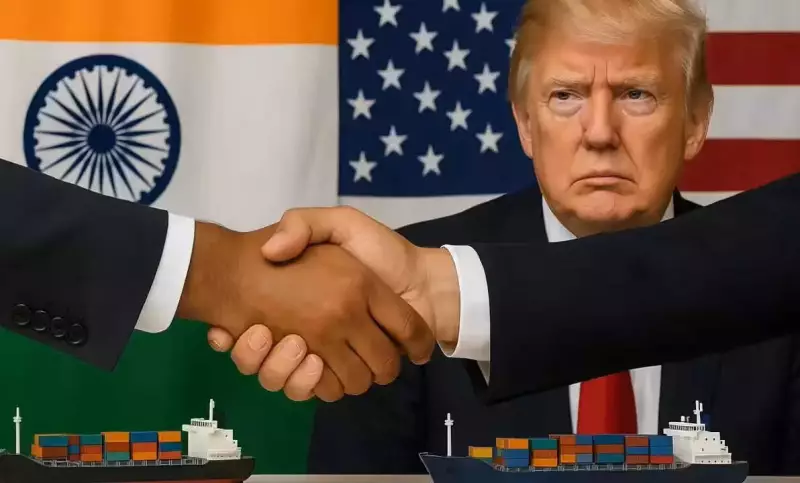
In a significant move with major implications for global energy trade, US President Donald Trump has given his approval to a new bipartisan sanctions bill. This legislation, known as the 'Sanctioning Russia Act of 2025,' authorises the imposition of massive tariffs—potentially as high as 500%—on countries that import Russian petroleum products and uranium. The development poses a direct challenge to India, a major buyer of discounted Russian crude, and threatens to further strain its economic relationship with Washington.
The Core of the Sanctions Bill
The proposed legislation, which is now headed for bipartisan approval, sets out sweeping punitive measures. These would be triggered if the US President determines that the Russian government has refused to negotiate a peace agreement with Ukraine, violated an existing peace deal, initiated another invasion, or sought to subvert the Ukrainian government.
The bill mandates that the President "must increase the rate of duty on all goods and services imported into the United States from countries that knowingly engage in the exchange of Russian-origin uranium and petroleum products to at least 500% relative to the value of such goods and services." This represents a drastic escalation in the US strategy to financially isolate Moscow.

Targeting Nations Like India and China
US Senator Lindsey Graham, a key architect of the bill, explicitly named India, China, and Brazil as targets. Following a meeting with President Trump, Graham stated that the legislation aims to "punish those countries who buy cheap Russian oil fueling Putin’s war machine." He argued it would give Trump "tremendous leverage" to incentivise these nations to stop purchases that provide "financing for Putin’s bloodbath against Ukraine."
This comes against the backdrop of existing trade tensions. Earlier this week, Graham revealed that India’s Ambassador to the US, Vinay Mohan Kwatra, met him last month to highlight New Delhi’s reduced purchases of Russian oil and to seek relief from additional 25% duties imposed by the US in August 2025. With that extra levy, total duties on certain Indian goods had risen to 50%.
India's Stance and the Growing Friction
President Trump has openly acknowledged that the tariffs have created friction with Prime Minister Narendra Modi. Speaking at the House GOP Member Retreat, Trump noted, "He’s not that happy with me because, you know, they’re paying a lot of tariffs now... but they are — they’ve now reduced it very substantially, as you know, from Russia."
However, the US President has repeatedly warned India that tariffs could be increased further if it does not "help on the Russian oil issue," directly linking trade policy to the Russia-Ukraine conflict. India has maintained a firm diplomatic stance, previously rejecting Trump’s claim that PM Modi had assured him New Delhi would stop buying Russian oil, clarifying that no such conversation took place.
As the 'Sanctioning Russia Act of 2025' advances through the US legislative process, it introduces fresh uncertainty for India's energy security and trade calculus. The bill signifies a hardening US approach, using trade as a primary tool to enforce foreign policy objectives, which could lead to a complex recalibration of the strategic partnership between Washington and New Delhi.






