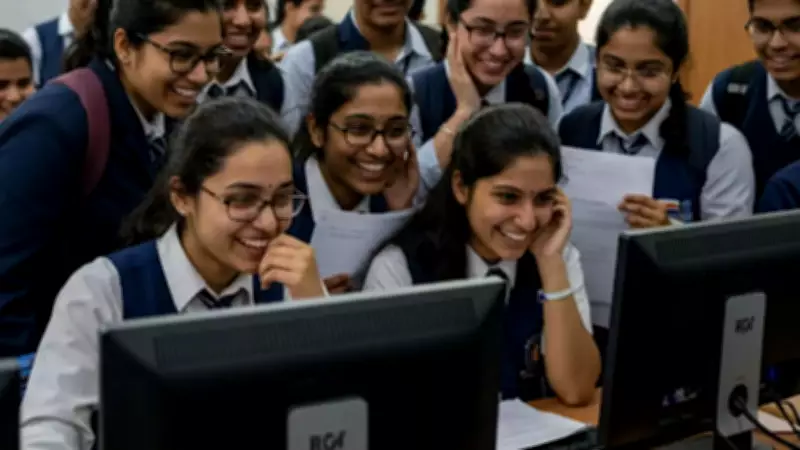
The Gujarat Secondary and Higher Secondary Education Board (GSEB) has declared the Class 12 Higher Secondary Certificate (HSC) results for 2026. The data shows a familiar pattern: girls have recorded higher pass percentages than boys across both General and Science streams, continuing a trend visible in recent years.
Girls vs Boys: The Gap Holds
The difference between male and female performance is not marginal. It is consistent across streams and categories. In the General stream, female candidates recorded a pass percentage of 95.41 per cent, compared to 90.10 per cent for male candidates. In the Science stream, the gap is narrower but remains in place. Girls recorded 84.65 per cent, while boys stood at 84.04 per cent. The direction is the same in both streams, but the scale differs.
What the Numbers Show
The General stream carries the largest share of candidates. Out of 4,35,102 students who appeared, over 4,03,362 qualified. The overall pass percentage stands at 92.71 per cent. Within this, female candidates not only outperformed male candidates in percentage terms but also in absolute qualified numbers. Male candidates qualified: 1,99,607; female candidates qualified: 2,03,755. This difference reflects both participation and performance. In the Science stream, 93,678 out of 1,11,090 candidates qualified, taking the pass percentage to 84.33 per cent. Here too, female candidates maintained a higher success rate despite lower registration numbers.

A Stable Pattern, Not a One-Off
The 2026 results do not mark a shift. They reinforce an existing pattern. The board’s year-on-year data shows that female candidates have consistently recorded higher pass percentages than male candidates in the General stream. In 2025, the gap was already visible, and in 2026 it has widened slightly. In the Science stream, the difference has remained narrower but stable, with girls maintaining a slight lead in both years. This suggests that the gap is structural, not incidental.
Participation Versus Outcomes
The data points to two simultaneous realities. Male candidates outnumber female candidates in registrations in the General stream. Yet, female candidates convert participation into outcomes more efficiently. For instance, as shown in the official booklet, male registrations stand at 2,22,222 compared to 2,14,350 female candidates. However, the qualifying percentage tilts in favour of girls. In the Science stream, registrations are closer, but the outcome gap remains. The pattern repeats across streams.
What This Means for Students
The results underline a shift that has been building over time. Female students are not only closing participation gaps but are now leading in outcomes. This has implications beyond board results. It shapes access to higher education, competitive exams and professional courses, where eligibility thresholds depend on these scores. For male students, the issue is not access but conversion. The gap is not in appearing; it is in qualifying.
Result Access and Process
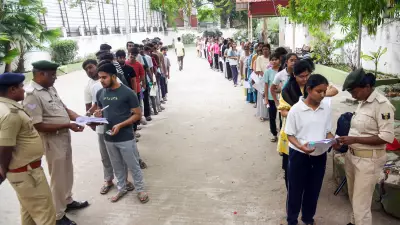
The results were declared at 10:00 AM and are available on the official website. Students can access their scorecards using their six-digit seat number. The board has also enabled WhatsApp and Short Message Service (SMS) channels to manage high traffic. These alternative systems are intended to reduce delays during peak access hours. The provisional marksheet includes subject-wise marks, grades and qualifying status. Students must secure at least 33 per cent in each subject and overall to pass.
What to Watch
The gender gap is now a stable feature of the GSEB HSC results. The question is no longer whether it exists, but whether it will widen or narrow. Future data will need to be read alongside subject choices, stream shifts and district-level outcomes. For now, the signal is clear: girls are not only keeping pace, they are setting the benchmark.