Across India's school ecosystem, investiture ceremonies have long served a ceremonial function, a formal passing of the baton, heavy on pageantry and light on intent. Yet something is quietly shifting. A growing number of institutions are reimagining these occasions not as performative rituals but as genuine inflection points in a student's formation - moments where the weight of a badge is meant to be felt, not merely worn. The conversation around student governance in schools has evolved considerably, moving from appointment-based councils to systems built around elections, assessments, and accountability.
Shifting Paradigms in Student Leadership
At the heart of this shift is a more grounded understanding of what leadership preparation should entail. Selection processes that once relied on teacher nominations or academic rank are giving way to multi-stage evaluations like written assessments, interviews, fitness parameters, and peer voting. The underlying reasoning is fairly simple: if schools are to produce citizens capable of democratic participation and ethical decision-making, the structures within the school must reflect those same values. There is also a growing view among educators that waiting until the secondary years to introduce leadership structures may be leaving something on the table.
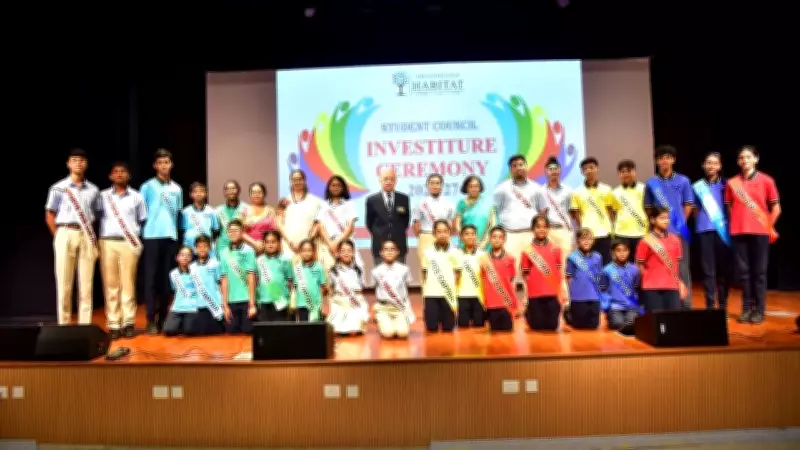
The Knowledge Habitat's Investiture Ceremony 2026-27
It is within this context that The Knowledge Habitat held its Investiture Ceremony for the academic year 2026-27. The occasion also marked the formation of the school's first Junior Students' Council, with elected representatives drawn from Grades IV and V, an addition that extended formal student leadership to the primary section for the first time.

Selection Process
The selection process involved multiple stages. Nominated candidates underwent a written test, viva, and fitness assessment, following which shortlisted students campaigned for their respective positions. Voting was conducted by students of Grades IV, V, and IX through XII. Academic merit, communicative ability, and physical readiness were among the eligibility criteria, with the process designed to assess a range of competencies rather than a single measure of suitability.
Ceremony Highlights
Chief Guest Air Commodore V.T. Parnaik (Retd.) presided over the proceedings. Principal Dr Amruta Prabhu addressed the gathering, noting that "the crown of victory rests on the brow of hard work." A March Past by the newly elected Students' Council preceded the pinning of badges - first for Junior Council members from Grades IV and V, representing the school's five houses - Agni, Ambar, Neer, Vasundhara, and Vayu; and then for the senior leaders. The Oath Ceremony, led by Head Girl Seerat Khandelwal, followed.
The passing-out parade was led by Senior Head Boy Harman Gill and Senior Head Girl Seerat Khandelwal, with Junior Head Boy Ayaansh Kumar and Junior Head Girl Swara Kulkarni, Cultural Secretary Saraanya Ganguly, and Sports Captain Parjeet Matharu also taking part. In his address, Air Commodore Parnaik spoke to the newly invested council about the relationship between knowledge and character, noting that competence and values need to develop together. A cultural performance and a Vote of Thanks delivered by Head Girl Seerat Khandelwal closed the event.
Implications for Student Development
With the addition of a Junior Students' Council, The Knowledge Habitat has quietly expanded the aperture of what student leadership looks like within its walls. The ceremony marked a beginning as much as a milestone, one that places younger students inside a structure of responsibility earlier than most schools typically do. Whether that early entry makes a meaningful difference is a question the institution has, in effect, chosen to answer through practice rather than policy.
Disclaimer: This article has been published on behalf of M3E Education by Times Internet’s Spotlight team.