Bharathidasan Institute of Management Reconnects with University After Decades-Long Rift
In a significant development for higher education in Tamil Nadu, the Bharathidasan Institute of Management (BIM) has agreed to restore certain ties with Bharathidasan University (BDU) and the state government, decades after distancing itself from both entities. This 'school of excellence,' originally established under the university's statutes, will now grant the university a formal role in its administrative and academic affairs.
Agreement Reached After High-Level Meeting
Representatives from BIM and BDU recently convened at the office of the higher education secretary, where they finalized an agreement to mend their fractured relationship. In a communication approved by BDU registrar R Kalidasan and issued by BIM director Asit Barma, the institute confirmed it will reinstate Rule 3(c) and (d) in its governing documents. These rules explicitly reference the 'university' and 'state government,' reaffirming BIM's status as a school of excellence under Bharathidasan University statutes.
The amendments to BIM's memorandum of association and society rules include several key provisions:

- The vice-chancellor of BDU, or a senior faculty member nominated by the VC, will now serve on BIM's board of governors.
- The VC will nominate one faculty member each to BIM's academic council and board of studies.
- Two members nominated by the VC will join a core committee responsible for addressing procedural requirements.
- BIM has committed to sharing the roster of admitted students and examination results for programs affiliated with the university.
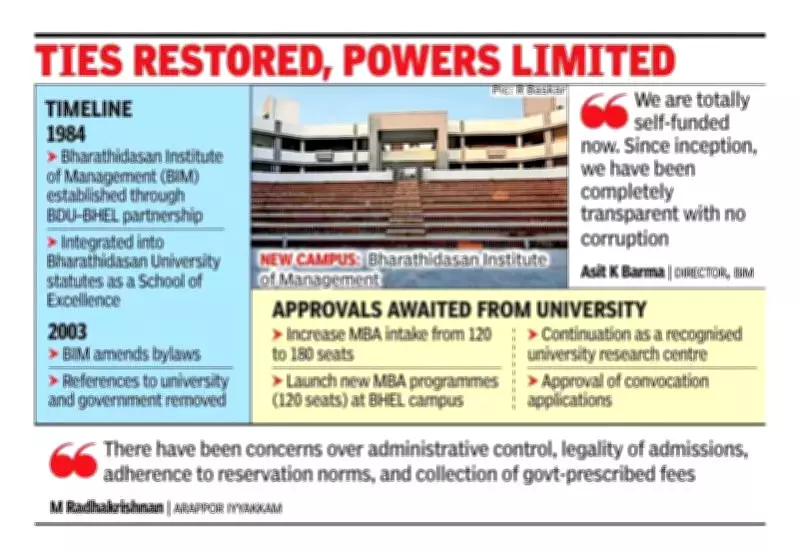
Additionally, BIM has sought approvals from BDU for operational matters, including a change of address for its existing MBA program, the addition of a new campus address at the upcoming BIM – Kalamavur campus, and permission to continue operating its research center under the university's umbrella.
Partial Concessions and Unresolved Issues
Despite these steps toward reconciliation, the agreement remains partial. Key powers that were originally part of BIM's bylaws but amended by the institute in 2003 have not been restored. Stakeholders have pointed out that the university's authority to oversee BIM's finances and conduct inquiries, if necessary, remains absent from the current arrangement.
Multiple registrars over the years have highlighted ambiguities in BIM's relationship with BDU, urging the higher education department to intervene. A syndicate sub-committee formed by the university in 2021 to examine certificate issuance noted that BDU continued issuing certificates primarily to protect students' interests, even after BIM distanced itself through what were described as 'unanimous' amendments.
As part of the new thaw, BDU has agreed to withdraw a writ appeal filed against BIM in 2022 concerning the issuance of degree certificates. This move signals a willingness to move past legal disputes and focus on collaborative governance.
Perspectives from Key Stakeholders
BIM director Asit K Barma emphasized that while BIM is permanently affiliated with BDU, it maintains autonomy in administration and finances. "We are totally self-funded now. Since inception, we have been completely transparent with no corruption. There have been misunderstandings between us, but it's like a family problem," he stated, underscoring the institute's independent yet cooperative stance.
However, not all parties are satisfied with the agreement. The anti-corruption NGO Arappor Iyakkam has demanded that the university investigate alleged irregularities at BIM over the past two decades. "The restoration is an eyewash. There have been concerns over administrative control, legality of admissions, adherence to reservation norms, and collection of government-prescribed fees," said M Radhakrishnan of Arappor Iyakkam, highlighting ongoing skepticism about the institute's practices.

A senior BDU official familiar with the developments offered a more optimistic view: "The agreement was, of course, not perfect, but it's a good restart. Once our members are nominated, we can look further ahead in our relationship." This perspective suggests that while challenges remain, the new framework provides a foundation for future collaboration and oversight.
The reconciliation between BIM and BDU marks a pivotal moment in the governance of higher education institutions in Tamil Nadu, balancing autonomy with accountability in a complex academic landscape.