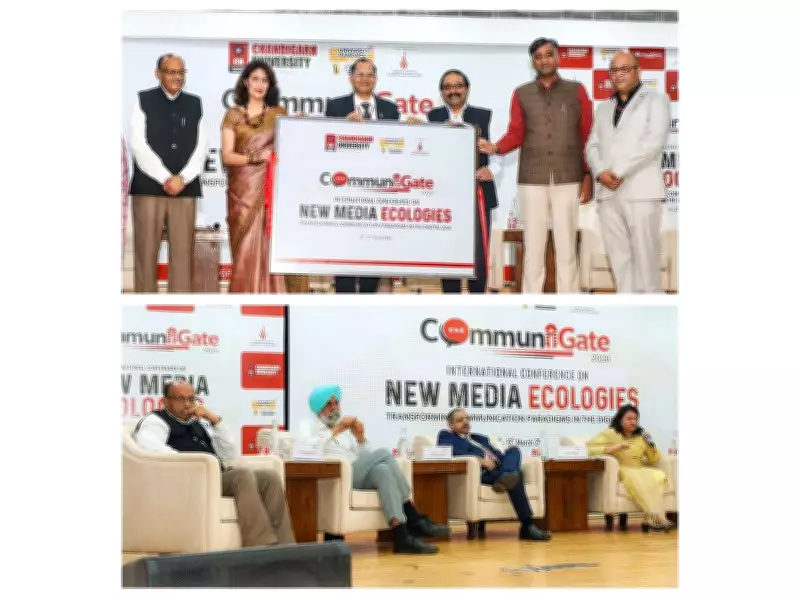
Chandigarh University Hosts CommuniGate 2026: A Landmark Conference on New Media Ecologies
Chandigarh University (CU), in collaboration with the Indian Council of Social Science Research (ICSSR), successfully organized CommuniGate 2026, an international conference focused on New Media Ecologies Transforming Communication Paradigms in the Digital Age. This two-day event, held at CU's University Institute of Media Studies (UIMS), provided a dynamic interdisciplinary platform for scholars, practitioners, policymakers, and emerging researchers to delve into the contemporary challenges and opportunities within the rapidly evolving digital communication landscape.
Distinguished Participants and Global Reach
The conference was graced by a host of eminent dignitaries, including:
- Prof (Dr) KG Suresh, veteran journalist and Director of India Habitat Centre
- Rabindra Narayan, MD and President of GTC Network
- Prof (Dr) Raviraj N Seetaraman, Vice-Chancellor of Chandigarh University
- Dr Nitin Kumar, Deputy Director (Research) at ICSSR
- Mimansa Malik, a veteran TV anchor
- Dr Mihir Ranjan Patra, Chairperson of DCMT at GJUST Hisar
- Prof Kulveen Trehan from GGSIPU
- Pallavi Srivastava, an entrepreneur and media professional
Approximately 60 research papers were presented during the technical sessions, showcasing contributions from research scholars across the globe. Participants hailed from countries such as Nigeria, Bahrain, and Venezuela, as well as various Indian states including Maharashtra, Kerala, West Bengal, Madhya Pradesh, Uttar Pradesh, Jammu and Kashmir, and Himachal Pradesh, highlighting the conference's international appeal and diverse perspectives.

Insights on Digital Transformation and AI
In his address, Deepinder Singh Sandhu, Senior Managing Director of Chandigarh University, emphasized the profound impact of digital technologies on communication. He stated, "As communication systems undergo transformation in this digital age, social media platforms, algorithmic systems, Artificial Intelligence, immersive technologies, mobile communication, and participatory cultures are collectively reshaping public discourse, cultural expression, governance, and everyday life." He underscored that CommuniGate 2026 served as a vibrant platform for critical deliberation on these transformative dynamics and their implications for democracy, culture, education, migration, and social inclusion.
Renowned media experts at the conference acknowledged that while AI and emerging technologies are revolutionizing media, the human touch remains paramount for authentic storytelling and quality journalism. Rabindra Narayan, in his valedictory address, remarked, "AI is as good as the person giving it the prompt. We should keep learning and applying our minds to what AI is doing for us. Real stories are in real places with real people; you must go there, find them, and tell them because only real stories survive." He encouraged attendees to embrace new tools while maintaining foundational journalistic principles.
Ethical Practices and Future Directions
Prof (Dr) KG Suresh, in his keynote address, highlighted the rapid transformation of journalism driven by new media, social platforms, and AI. He pointed out that while traditional roles are evolving, the spread of misinformation remains a significant concern. He stressed the necessity for technological competence, ethical practices, and human-interest-driven reporting in modern journalism.
Mimansa Malik added to this discourse by noting, "The phone in our hand holds more power today than any news channel did 30 years ago. Young journalists should balance representation with ideological awareness." She emphasized the importance of ethical citizen journalism, engaging storytelling, and responsible use of AI for fact-checking, urging creators to understand algorithms and leverage digital platforms for social change while maintaining originality.

Dr Nitin Kumar from ICSSR focused on the ethical dimensions, calling for responsible usage and regulation of digital platforms. He advocated for a collaborative relationship between technology, media, and society, with proactive participation from policymakers. He suggested shifting the focus from how technology transforms communication to how communication transforms democracy, highlighting the broader societal impacts.
About Chandigarh University
Chandigarh University is a NAAC A+ Grade University and QS World Ranked institution, approved by the UGC. Located near Chandigarh in Punjab, it is the youngest university in India and the only private university in the state to receive an A+ Grade from NAAC. CU offers over 109 UG and PG programs across diverse fields such as engineering, management, pharmacy, law, architecture, journalism, animation, hotel management, and commerce. It has been recognized as The University with Best Placements by WCRC, underscoring its commitment to academic excellence and career readiness.