NCrF Aims to Transform Education with Flexible Credit System from LKG to PhD
At the Development Dialogue organized by the Deshpande Foundation in Hubballi on Saturday, retired IAS officer EV Ramanareddy expressed optimism that the National Credit Framework (NCrF), currently in the implementation stage, will enable universities and employers to verify student credits from LKG to PhD. This initiative is set to shift higher education towards more flexible, competency-based pathways, moving away from rigid, degree-centric systems.
Empowering Students with Choice and Industry-Ready Skills
Ramanareddy highlighted that the NCrF allows students to choose diverse subjects, such as combining physics and music, fostering interdisciplinary learning. He also discussed the emergence of university townships, where academic and industry sectors will integrate school and college facilities in one location in the coming years, enhancing collaboration and practical exposure.
In a significant move to boost global opportunities, Ramanareddy announced that the Karnataka government is establishing language laboratories to empower engineers from the state to work in countries like Japan and Germany. This initiative addresses the need for linguistic skills in international markets, though he noted that scaling and execution remain key challenges in transitioning to competency-based frameworks.

Bridging the Gap Between Education and Workforce Needs
Rajan, an advisory board member of The Convergence Foundation, emphasized that customized learning empowers the younger generation to pursue their interests. He pointed out the persistent gap between education outcomes and workforce demands, calling for industry-aligned curricula and skill-based pathways to better prepare students for real-world challenges.
Future of Education: From Answering to Asking Questions
Gururaj Deshpande, founder of the Deshpande Foundation, predicted a paradigm shift in education, where writing answers in exams will be replaced by candidates asking questions. He stated, "The AI industry will create all kinds of jobs, but job seekers should have the confidence, understand their role, and adopt vocational skills." Deshpande urged a move from isolated success stories to large-scale, system-wide transformation to foster innovation and adaptability.
Moderated Insights on Leadership and Governance
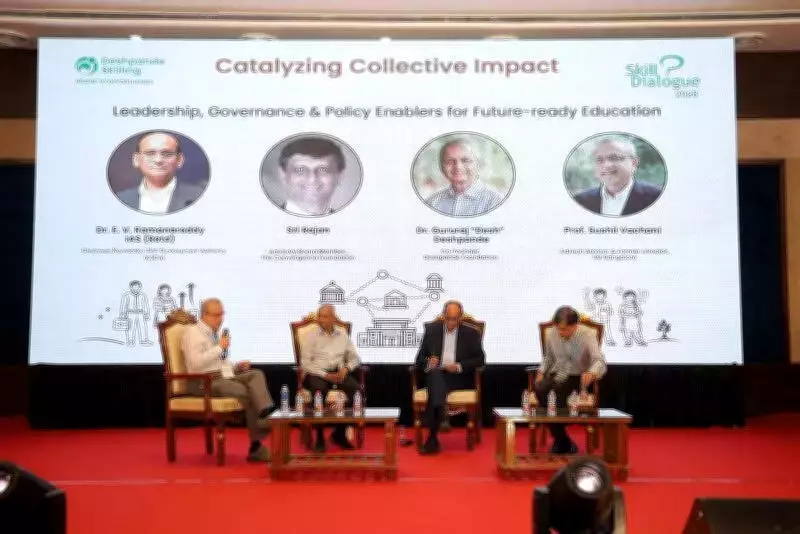
The session, titled 'Catalyzing Collective Impact: Leadership, Governance, and Policy Enablers for Future-ready Education', was moderated by Prof Sushil Vachani, an EdTech advisor and former director of IIM Bangalore. Experts shared their thoughts on how leadership and governance can drive policy changes to create a more responsive and effective education system.
Overall, the dialogue underscored the need for collaborative efforts among policymakers, educators, and industry leaders to implement frameworks like the NCrF and language labs, ensuring that education evolves to meet future demands and empowers students with relevant skills and opportunities.