NEP 2020's Liberal Education Framework Transforms Campus Life in Andhra Pradesh
The National Education Policy (NEP) 2020 has ushered in a transformative era for higher education across India, with its emphasis on a liberal education model that empowers students to explore diverse academic interests. This innovative approach grants learners the freedom to select minors and electives from disciplines far beyond their primary subjects, fostering holistic development and intellectual curiosity.
Vāggēyakara Vaibhavam Event Showcases NEP Implementation
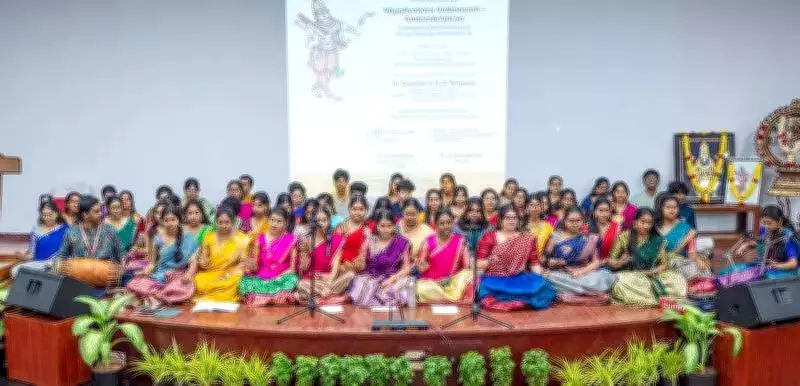
This progressive educational philosophy came alive during the 'Vāggēyakara Vaibhavam - Annamacharya' celebration at Gitam Deemed to be University in Visakhapatnam on February 2. The event witnessed approximately fifty talented students presenting an enchanting dance and music program before an audience comprising hundreds of faculty members, fellow students, and distinguished music exponents.
The program paid tribute to the life and enduring legacy of Tallapaka Annamacharya, revered as the Tholi Telugu Vāggēyakarudu (the first Telugu composer). Following captivating performances by eminent Carnatic musician Dr. Dwaram VKG Tyagaraj and his accomplished disciples from outside the university, around fifty Gitam students took the stage, demonstrating their artistic prowess cultivated through the university's elective programs.

Student Voices: Passion Meets Academic Commitment
The event served as a powerful testament to how NEP's flexible framework is actively reshaping campus culture and encouraging students to pursue interests beyond conventional academics. Several state and private universities throughout Andhra Pradesh have enthusiastically adopted this liberal education model in recent years.
Kasibhatla Krishna Saketh, a first-year BSc microbiology student, and K Sanjana, a second-year BBA student, shared how choosing Carnatic music as a minor has enabled them to follow their artistic passion while maintaining their academic responsibilities. They emphasized that these courses are thoughtfully designed to integrate seamlessly with their schedules, allowing for dedicated learning without disrupting regular classes.
Pekala Chinmayi, a first-year BTech (Computer Science and Engineering) student, and Badampudi Purna Srija, a biotechnology student, expressed that the opportunity to merge their passions with career aspirations through minors has been an exceptionally rewarding experience. They noted, "Such programs support comprehensive personal development, alleviate academic stress, enhance concentration levels, and may potentially unlock future career pathways in creative fields."
Institutional Adoption and Curriculum Design
Officials from another private university highlighted the significant advantages for students, explaining that NEP's liberal education framework enables them to pursue their passions alongside rigorous academic studies. They remarked, "Previously, students had to pursue extracurricular interests either early in the morning or after regular class hours. Now, this system functions almost like a dual-degree program. We plan to launch these innovative programs from the next academic year."
Dr. K Maalyada, head of the Department of Fine and Performing Arts at Gitam University, provided revealing statistics about student participation. Nearly 300 undergraduate students have enrolled in minor programs, while approximately 400 students have selected electives across various disciplines including:
- Kuchipudi
- Bharatanatyam
- Carnatic vocal music
- Mridangam
- Theatre arts
- Fine arts
Dr. Maalyada elaborated on the curriculum structure, stating, "The program is meticulously designed with a progressive framework, moving from introductory and basic levels to intermediate and advanced stages across multiple semesters. Many students have achieved advanced proficiency without requiring external coaching, as the electives provide robust foundational training within the university ecosystem."

This educational evolution represents a significant shift toward creating more versatile, well-rounded graduates equipped with both specialized knowledge and diverse skills, perfectly aligning with NEP 2020's vision for India's future education landscape.